For many international sellers, registering with the Single-Use Plastics Fund (EWKF) via the DIVID portal is a major compliance hurdle. Unlike the LUCID registry, which covers almost all packaging, DIVID specifically targets products that frequently end up as litter in public spaces.
Status of this article: All details were verified in August 2026 against the official publications of the German Environment Agency (UBA) and the statutory text. Two recent changes matter in particular: the 500-gram quantity threshold (introduced on 3 November 2025) and the inclusion of fireworks from 2026.
Step 1 — Check whether DIVID applies to your products
A simple rule of thumb: this is a "public space cleanup fund". If your product contains plastic and is typically consumed on the go and then discarded in public areas — parks, streets or nature — there is a very high probability that you fall under this regulation.
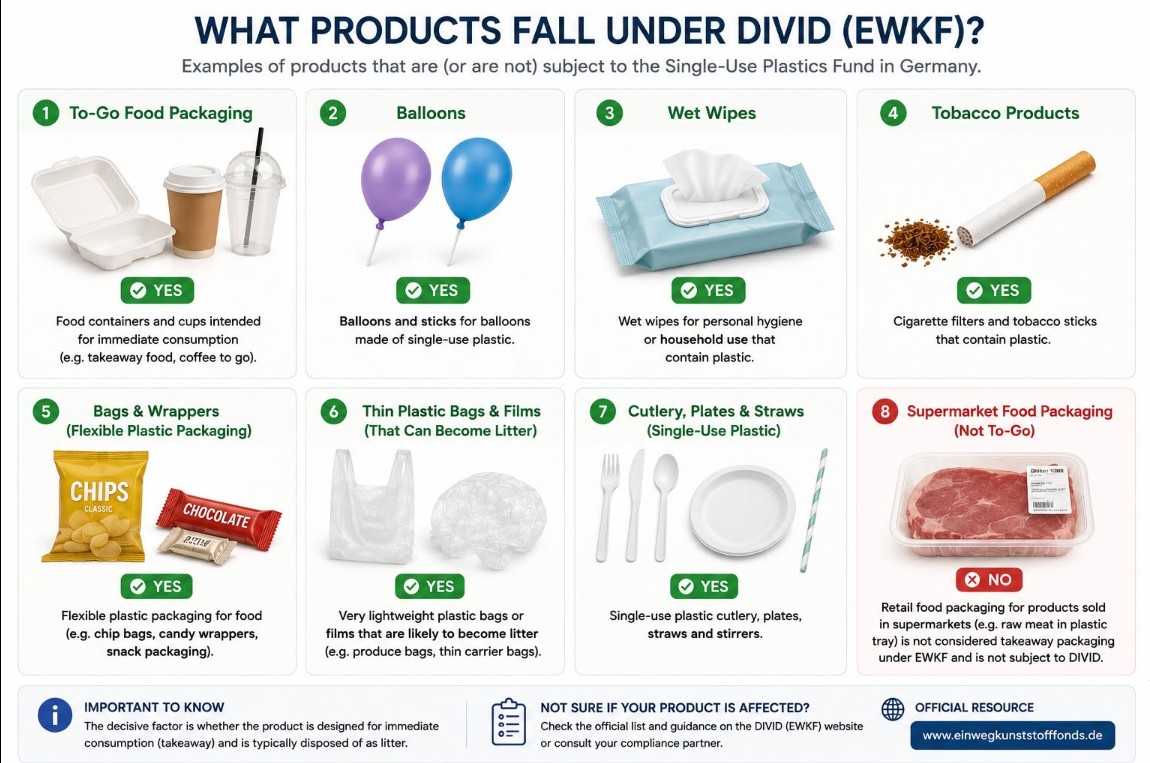
What counts is the exhaustive list in Annex 1 of the EWKFondsG (statutory text). Only the product types named there trigger a payment obligation:
| Product type (Annex 1 EWKFondsG) | Subject to DIVID? | Details |
|---|---|---|
| Food containers | YES | Boxes for food intended for immediate consumption (take-away), requiring no further preparation. |
| Packets and wrappers | YES | Flexible packaging with food contents for immediate consumption (e.g. crisps, sweets). |
| Beverage containers up to 3.0 litres | YES | Bottles and composite packaging, including caps and lids. |
| Beverage cups | YES | Including their caps and lids. |
| Lightweight plastic carrier bags | YES | Wall thickness below 50 microns, handed out at the point of sale. |
| Wet wipes | YES | Pre-wetted wipes for personal or household care. |
| Balloons | YES | Excluding balloons for industrial or commercial applications. |
| Tobacco products with filters | YES | Cigarette filters and filters sold separately. |
| Fireworks | YES — new from 2026 | Newly added to Annex 1; registration deadline 31 December 2026. |
| Plain shipping cartons | NO | Transport packaging without single-use plastic — LUCID only. |
The 500-gram threshold: significant relief since November 2025
On 3 November 2025, the UBA introduced a quantity threshold of 500 grams by administrative provision. Packets, wrappers and food containers whose intended food content exceeds 500 grams are no longer regarded as products for immediate consumption — and are therefore no longer subject to the levy.
The threshold applies correspondingly to empty food containers such as take-away boxes or salad bowls. Where the later fill quantity is unknown, the typical fill weight of comparable containers is used.
What this means in practice: the film wrapping of a 750-gram Christmas stollen is no longer subject to the levy. Family-sized packaging for baked goods, delicatessen products, meat and ready meals is particularly affected. If you have already reported quantities above this threshold for earlier periods, you should review your declarations and correct them where necessary.
What the levy actually costs
The amount of the single-use plastics levy is set out bindingly in § 2 of the Single-Use Plastics Fund Ordinance (EWKFondsV) — per kilogram of products placed on the market:
| Product type | Levy per kilogram |
|---|---|
| Food containers | €0.177 |
| Packets and wrappers | €0.876 |
| Beverage containers (non-deposit) | €0.181 |
| Beverage containers (deposit) | €0.001 |
| Beverage cups | €1.236 |
| Lightweight plastic carrier bags | €3.801 |
| Wet wipes | €0.061 |
| Balloons | €4.340 |
| Tobacco products with filters | €8.972 |
The spread is considerable: the factor between deposit beverage containers and tobacco filters is 8,972. For budgeting purposes, correct product classification therefore matters more than total mass alone.
Step 2 — Choose the correct registration type
When you access the DIVID portal (einwegkunststofffonds.de), you must select your account category based on where your company is established:
Producer established in Germany (Inland): for companies with a physical branch or headquarters in Germany.
Producer without establishment in Germany (Ausland): for international sellers based outside Germany. This is the category for most cross-border e-commerce sellers.
Authorised Representative: a separate account type for German service providers acting on behalf of foreign companies.
Crucial rule: if your company is based outside Germany, you have been legally required to appoint an Authorised Representative in Germany since 1 January 2024.
Step 3 — Creating your account
The initial setup requires basic company information. Have the following ready:
Name (company): full legal business name exactly as per your tax documents.
Corporate form: your legal structure (e.g. GmbH, Ltd, LLC, sole proprietorship).
Street, number / Postcode / Place: your official business address.
Country: your company's home country.
Natural person with power to represent: the name of the director or authorised signatory.
E-mail address: a permanent business email. This will be your login and the address for official notices from the UBA.
Important note: the registration must be carried out personally by the producer and cannot be done by a third party. Your Authorised Representative then takes over the fulfilment of the obligations — but not the creation of the account itself.
During registration, your details are also cross-checked against the master data held in LUCID. Make sure your company name and address are spelled identically in both registers.
Step 4 — Appointing your Authorised Representative
Because foreign companies cannot directly discharge their environmental duties in Germany, you must formally link your account to a representative:
Mandate: sign a formal written mandate with a German service company. The law requires the appointment to be made in the German language.
Upload: search for and select your representative in the DIVID portal and upload the signed contract as a PDF.
Confirmation: the registration only becomes active after your representative confirms the link in their own portal.
One representative only: each producer may appoint only one Authorised Representative at a time.
Practical tip: the UBA publishes a continuously updated list of Authorised Representatives who have consented to publication on its EWKF page. That list is a good starting point for choosing a reputable partner.
Step 5 — Annual quantity reporting and payment
Registration is only the first step. Every year you must report the total mass of the relevant single-use plastic products you placed on, or sold into, the German market:
Deadline: 15 May for the preceding calendar year.
Payment: the UBA assesses the levy on the basis of your report and the statutory rates. The funds are passed on to municipalities to reimburse the costs of cleaning public spaces.
Audit requirement from 100 kilograms: once the total mass of single-use plastic products placed on the market or sold reaches 100 kilograms, the quantity report generally requires prior verification and confirmation by a registered auditor. Eligible auditors are registered experts as well as auditors, tax advisors and sworn accountants registered under § 27 VerpackG. The UBA also maintains a public list for this purpose.
Audit guidelines: the audit guidelines published since October 2025 apply from reference year 2025 and set high standards for documentation, IT traceability, product classification and internal controls. If you are above the 100-kilogram mark, plan the audit process early — not in May.
Why Amazon and eBay ask for your DIVID number
Since 1 January 2025, operators of electronic marketplaces and fulfilment service providers have been legally prohibited from offering single-use plastic products from unregistered producers. That is the real reason behind the requests from Amazon and eBay — the platforms are not enforcing their own corporate policy, they are meeting a statutory obligation.
The UBA also states explicitly that missing or improper registration is intended to trigger automatic distribution bans: the products concerned may then neither be made available on the market nor sold. The public producer register on DIVID is searchable alphabetically — platform operators and business partners can verify your registration there themselves at any time.
Frequently asked questions
Do I need DIVID if I already have LUCID?
Not necessarily. If you sell items without single-use plastic components (such as wooden toys), you need LUCID but not DIVID. LUCID covers packaging in general; DIVID applies specifically to the product types listed in Annex 1. Conversely, paying your dual system fee under the Packaging Act does not replace the EWKF levy — these are two separate obligations with different purposes: household collection on the one hand, public bins and street cleaning on the other.
Does Amazon handle DIVID for me?
No. Amazon requires your registration number to keep your listings active — but registration, reporting and payment remain your responsibility, either directly or via your Authorised Representative.
Is an Authorised Representative always required?
For producers without an establishment in Germany: yes, this has been a strict legal requirement since 1 January 2024.
What applies to products near the 500-gram limit?
What counts is the intended food content. If it exceeds 500 grams, the levy obligation for that packaging falls away. Where the fill quantity is unknown, comparable containers are used as a reference. For products below the threshold, the previous classification criteria remain unchanged.
Final thoughts
The DIVID system holds producers accountable for the cleanup costs their products generate in public spaces. If your products contribute to that litter, compliance is not optional — missing registration now leads directly to distribution bans and exclusion from marketplaces.
Start by checking Annex 1 to see whether your product types are covered at all, factor in the 500-gram threshold, and if your volumes exceed 100 kilograms, schedule the audit well in advance.
Official sources
- DIVID / Single-Use Plastics Fund — official portal
- German Environment Agency: EWKF page
- EWKFondsG — statutory text
- EWKFondsV — levy rates (§ 2)