Germany is one of the biggest Amazon markets in Europe. Many international sellers want to expand there because of the large customer base and strong purchasing power. At the same time, Germany is known for strict regulations and marketplace rules that often catch new sellers off guard.
The good news: thousands of international sellers operate successfully in Germany today. The key is understanding the system early and avoiding expensive beginner mistakes.
Germany is Amazon's largest market in Europe
Germany remains Amazon's most important marketplace in Europe and one of its largest markets worldwide outside the United States.
How to read these figures: Amazon discloses separate revenue only for the USA, Germany, the UK and Japan. Figures for other countries are third-party estimates. These are also Amazon's net sales (first-party retail plus marketplace seller fees) — not third-party seller GMV.
| Country | Net sales 2025 | Source |
|---|---|---|
| USA | USD 489.7bn | Amazon annual report |
| Germany | USD 45.9bn | Amazon annual report |
| United Kingdom | USD 43.2bn | Amazon annual report |
| Japan | around USD 30bn | Annual report, +12.0% vs 2024 |
| France, Italy, Spain, others | not disclosed separately | third-party estimates only |
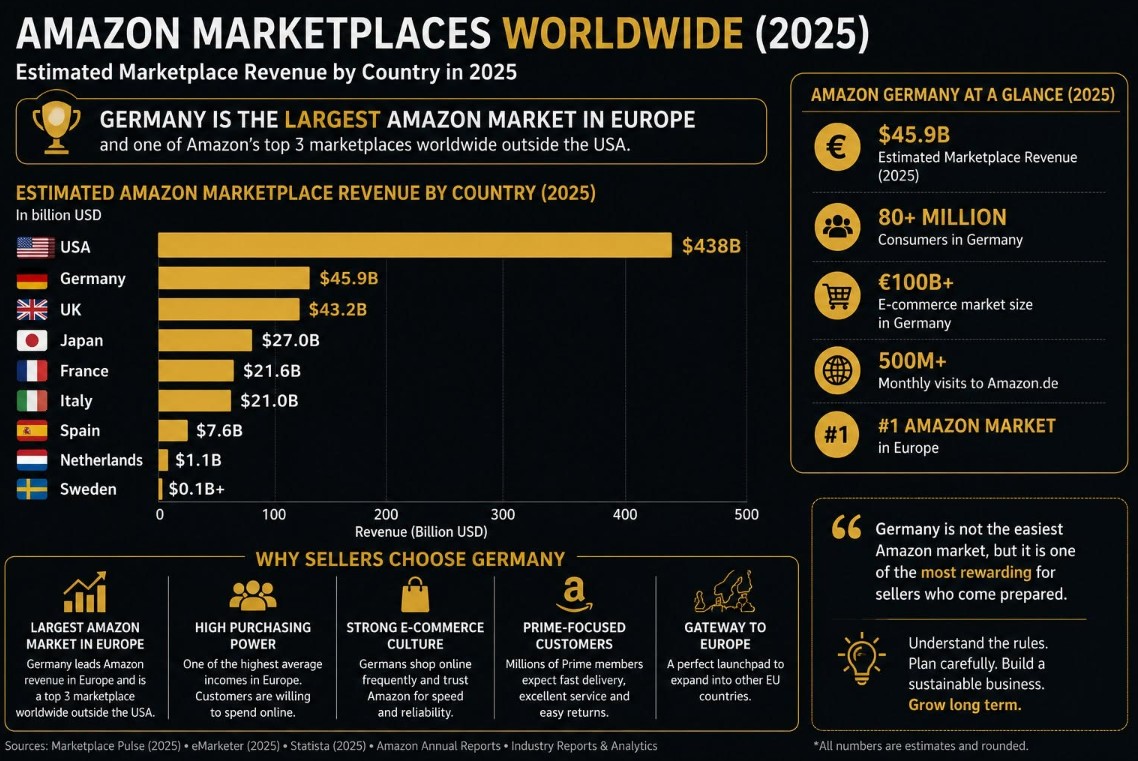
The momentum is notable: Amazon's revenue in Germany grew by roughly 12 percent in 2025 — faster than in the United States (11.8 percent). The UK, however, is catching up and now sits close behind Germany.
Add to this: more than 80 million consumers, one of Europe's strongest e-commerce economies, and over 500 million monthly visits to Amazon.de. For many sellers, Germany becomes the gateway into the wider European market.
1. Germany takes compliance seriously
Many sellers believe Amazon handles everything automatically. That is not the case.
Even when selling through Fulfillment by Amazon (FBA), you generally remain responsible for: packaging compliance, VAT obligations, product regulations and EPR registrations.
Amazon can request compliance information and deactivate listings if required data is missing (Amazon EPR information). Since 1 July 2022 this is no longer merely corporate policy: marketplace operators and fulfilment service providers are legally prohibited from offering products from unregistered producers.
2. LUCID packaging registration is often required
If you place packaged goods on the German market, you usually need a LUCID registration number (lucid.verpackungsregister.org) and participation in a packaging licensing system. This applies to many foreign Amazon sellers as well.
A common misconception is: "I only sell online, so this doesn't apply to me." In most cases, it still does.
Important since 2026: foreign producers without a German establishment who supply end users directly must additionally appoint an Authorised Representative in Germany — mandatory since 12 August 2026. Before that, the appointment was voluntary.
3. High revenue does not automatically mean high profit
Germany is a competitive market. Many new sellers look only at revenue, product trends and sales velocity.
Real profitability, however, also depends on: PPC costs, returns, VAT, storage fees, compliance overhead and cash flow.
Some businesses grow fast and still run into financial trouble because costs get away from them. Sellers who track profitability closely and keep expenses under control usually build a considerably more stable business over time.
4. German Amazon customers return products frequently
This is something new sellers regularly underestimate. In Germany, returns are entirely routine for customers — sometimes for minor reasons: the packaging feels disappointing, the product presentation differs from the photos, expectations were slightly different, or they simply changed their mind.
In some product categories, return rates can climb very high. That creates additional costs: return processing, damaged inventory, refunds, wasted advertising spend and warehouse fees.
Some businesses focus solely on sales volume while returns quietly erode profitability. That is why accurate product photos, realistic descriptions, sturdy packaging and clearly set customer expectations matter so much in the German market.
The positive side: German customers value consistency, quality, honest descriptions and professional sellers. Businesses that build trust often gain loyal long-term customers.
5. Logistics and inventory planning matter
Germany can be an excellent FBA market, but inventory problems become expensive quickly. Keep an eye on: storage limits, restock timing, warehouse planning, stranded inventory and long-term storage fees.
Poor stock planning damages both rankings and cash flow. Many experienced sellers recommend starting smaller, learning the system first and scaling gradually rather than ordering large quantities too early.
6. The rules change
Germany and the EU keep introducing new marketplace and environmental regulations. Do not assume older information still applies.
What has changed recently:
• Since 1 January 2025: marketplaces and fulfilment providers may no longer offer single-use plastic products from producers not registered with DIVID (EWKFondsG).
• Since 1 January 2024: an Authorised Representative for the Single-Use Plastics Fund (EWKF/DIVID) is mandatory for producers without a German establishment.
• Since 3 November 2025: the 500-gram threshold in the EWKF — packaging with more than 500 grams of food content is no longer subject to the levy.
• Since 12 August 2026: the VerpackDG is in force — an Authorised Representative is mandatory under packaging law too.
• From 2026: fireworks newly covered by the Single-Use Plastics Fund, registration due by 31 December 2026.
Final thoughts
Germany can be a very strong opportunity for Amazon sellers. But success usually takes more than uploading a product and running ads.
Understanding compliance, logistics and marketplace realities early prevents expensive mistakes later. For many sellers, preparation is exactly what separates long-term growth from constant problems.
Those who succeed long term are rarely the ones with the biggest budgets — they are the ones who stay informed, adapt quickly and build sustainable systems. Germany is not the easiest Amazon market, but for prepared sellers it can be one of the most rewarding.
Official sources
- Central Agency Packaging Register (ZSVR)
- LUCID — packaging register
- Amazon: extended producer responsibility
- VerpackG § 36 — penalty provisions
- Federal Central Tax Office (VAT)