Home FAQ Blog About Sample PPWR Generator PPWR Labels Get Free Advice
PPWR Art. 15 · Marking

Create PPWR Labels for Your Packaging

Create the mandatory information under Art. 15 PPWR — PPWR-ID, name, address and contact — as a print-ready PDF or as a text block for your label printer.
Who is this for? This tool is a transitional solution for packaging already produced and existing stock. For new print runs, we recommend integrating the mandatory information directly into your permanent packaging design — this generator shows you exactly what belongs there.
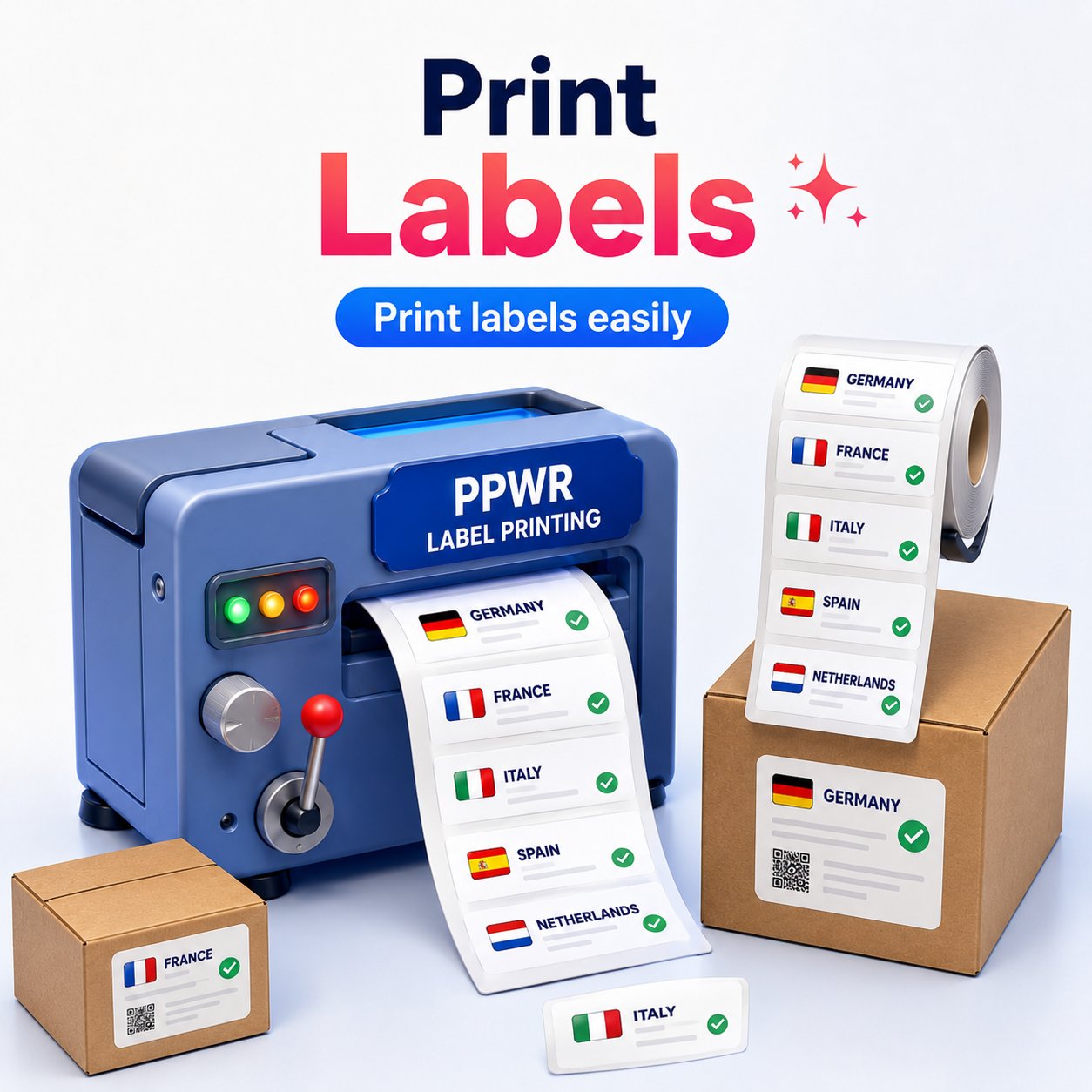
Print PPWR packaging labels — labels with flag, country name and QR code for different EU countries

1 Mandatory Information

This information must appear on every packaging — printed, stuck on, or via a QR code.

Don’t have a PPWR-ID yet? The PPWR-ID comes from your declaration of conformity — both documents need to match. If you haven’t declared this packaging yet, create the declaration of conformity first and come back here afterwards.
Must match the identifier entered as the Packaging ID in your declaration of conformity — not the declaration number of the document itself.
What if I already have a number?
Existing barcode: Art. 15 doesn’t strictly require a new number — it requires an element that clearly identifies the packaging. A GTIN/EAN barcode can do this, provided it can be assigned unambiguously to exactly this packaging. Careful: barcodes usually attach to the product, not the packaging — five honey varieties in the same jar means five barcodes but only one packaging. Then you need a separate Packaging ID.

Existing batch number: also usable, as long as the packaging can be traced independently through it — traceability has to work at packaging level, not only at product level.
Any one of the three is enough: your name, your registered trade name or your registered trademark.

What matters is whose brand appears on this packaging — which is normally you. If your product is sold under your own name, simply enter your company details.

Special case only: if you produce packaging under someone else’s brand (private label, e.g. filling for a retail chain), that brand’s details belong on the packaging — not yours.
An address at which you can actually be reached — a PO box alone is generally not sufficient.
Art. 15 requires electronic contact details where available. This isn’t an optional extra field: if your company has a business email address — and in practice it almost always does — it belongs here.

2 Three Quick Questions

An order often consists of several packaging categories — e.g. the jar with its own label (sales packaging) and separately the shipping box (transport packaging). Each category is assessed separately, needs its own marking and its own declaration of conformity. These three questions clarify what's still missing on this specific packaging — and who is responsible for it. Create a separate label for each category.

1. Are the name, address and contact already on the packaging — e.g. in an imprint or on a label?
Then we’ll only output the PPWR-ID — the name, address and contact are already there and don’t need to be duplicated.
2. Is the primary packaging (e.g. the jar or can) visible through the outer packaging?
If the primary packaging is not visible from the outside, the marking must be repeated on the opaque outer packaging — otherwise one location is enough.
3. Does this packaging layer already carry your own logo or brand name?
If this packaging is neutral or carries someone else's brand: if it comes from an EU-established supplier, the marking obligation generally lies with them — simply request their conformity evidence. But if you import this packaging yourself from a country outside the EU (e.g. China) and there's no EU-established manufacturer in the chain, you as the importer take on this obligation in full — you cannot legally rely on the supplier's word alone.

3 Output

Choose a PDF label to print, or a text block to forward to your print shop.

Live preview
PPWR-ID
Hersteller / Marke
Adresse
Kontakt

The field names on the label itself automatically match the selected destination country — that's where this packaging is sold, and the printed information must be in the language actually read by consumers and authorities there.

Note on responsibility: Responsibility for the legibility, placement and accuracy of the information on the packaging lies with the manufacturer. This tool only formats and transfers the data you enter — it does not check whether the placement on your specific packaging meets the requirements.

Transitional rule: Packaging already placed on the market before 12 August 2026 may continue to be used with its existing marking — an immediate changeover of existing stock is not required.
💬