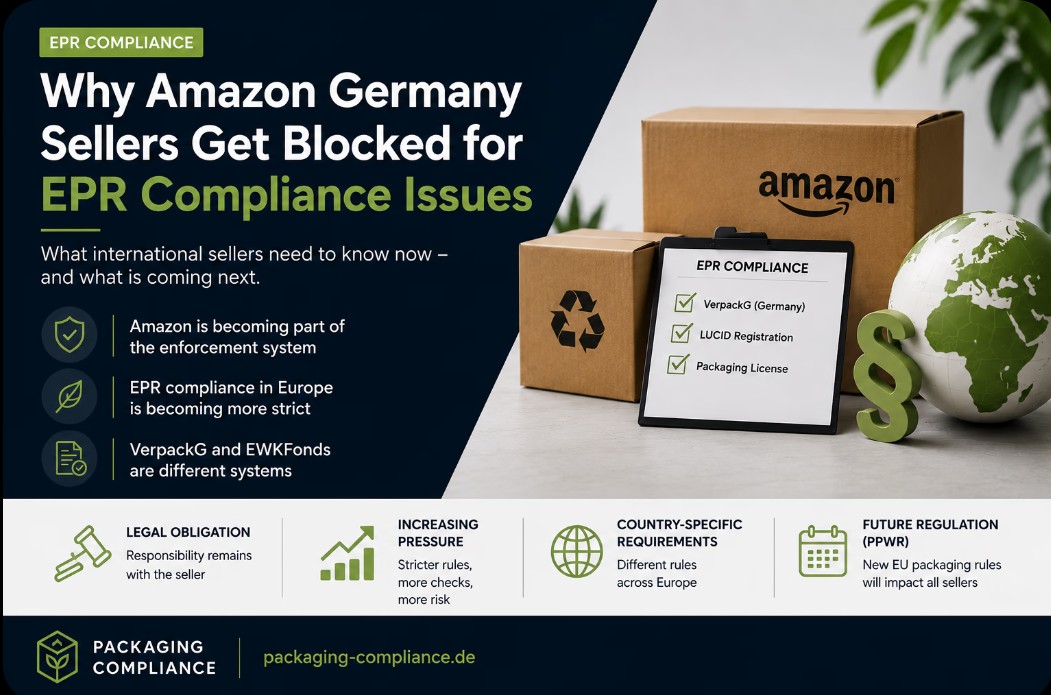
Many international Amazon sellers underestimate how seriously Germany treats EPR compliance. One of the most common misunderstandings is believing that Amazon automatically handles all environmental obligations on the seller's behalf. In reality, responsibility remains with the seller.
In recent years, Amazon and other marketplaces have increasingly requested EPR information — registration numbers, evidence, documentation. The result: many sellers only start looking into German requirements after receiving a warning or having listings restricted.
Status of this article: All details were verified in August 2026 against the statutory text and the official portals.
What is EPR in Germany?
Extended Producer Responsibility (EPR) is a legal framework that makes companies responsible for the environmental impact of certain products and packaging.
In Germany this may cover packaging (VerpackG), electronics (WEEE / ElektroG), batteries and certain single-use plastic products. Which obligations apply depends on product category, packaging type and how the products are sold.
Why foreign sellers are often confused
Germany runs one of the strictest environmental compliance systems in Europe. Many international sellers wrongly assume that Amazon handles everything, that FBA removes legal responsibility, or that one EU registration covers all European marketplaces.
None of those assumptions holds. European compliance systems are fragmented, country-specific — and now tightly interlinked with marketplace enforcement.
Amazon has become part of the enforcement system
This is the most important change, and many sellers have not fully grasped it: marketplaces are not requesting compliance data voluntarily. They are subject to legal obligations of their own.
Two rules make this concrete:
Since 1 January 2025, operators of electronic marketplaces and fulfilment service providers have been prohibited under the Single-Use Plastics Fund Act from offering products from unregistered producers.
Since 12 August 2026, Article 45(4) of the PPWR explicitly requires online marketplaces to verify that sellers are registered in the relevant country of sale.
That is why sellers increasingly encounter automated compliance checks, requests for registration numbers, listing suspensions and account-related warnings. The pressure does not come from Amazon alone — it reflects European environmental policy aimed at waste reduction, recycling targets, cutting single-use plastics and increasing producer responsibility.
Why compliance is becoming more complex
For many sellers the challenge is no longer obtaining a registration number. The hard part is understanding how the different environmental systems interact.
The VerpackG, the Single-Use Plastics Fund, WEEE, battery regulations and European packaging law can all apply differently depending on business model and product category. That is exactly why so many sellers struggle to determine which rules apply, which registrations are required and which reporting obligations exist.
PPWR: no longer the future, but current law
Here is a point where many guides are now out of date: the PPWR is often described as an "upcoming" regulation. That is no longer accurate.
The Packaging and Packaging Waste Regulation (Regulation (EU) 2025/40) was published in the Official Journal on 22 January 2025 and has applied since 12 August 2026. Unlike a directive, a regulation is directly applicable in all 27 Member States — no national transposition, no room for local variation.
In parallel, Germany's VerpackDG entered into force on 12 August 2026. Foreign producers without a German establishment who supply end users directly must since then appoint an authorised representative — before that, the appointment was voluntary.
The long-term direction of European environmental policy is therefore clear: less unnecessary packaging, more recyclable materials, lower packaging waste, stricter reporting and greater producer responsibility. For many businesses, compliance is shifting from a one-off registration to an ongoing operational responsibility.
Why small businesses feel overwhelmed
Large corporations have legal departments, compliance managers, specialised consultants and internal environmental teams. Small and medium-sized businesses usually do not.
So many Amazon sellers try to work through highly technical environmental regulations while simultaneously managing inventory, logistics, advertising, customer service and marketplace operations. That explains why confusion around EPR, the VerpackG and the Single-Use Plastics Fund is so widespread among smaller sellers.
Common mistakes international sellers make
Assuming Amazon handles everything. Amazon collects compliance data, but legal responsibility generally stays with the seller.
Registering only in LUCID. LUCID registration alone is often not enough. System participation, quantity reporting or further registrations usually follow. Under § 36 VerpackG, missing system participation is the most expensive breach at up to €200,000 — more than a missing registration at up to €100,000.
Ignoring country-specific rules. Europe is not a single unified compliance system. Germany, France, Spain and other countries each have their own environmental obligations and their own registers.
Confusing the VerpackG with the Single-Use Plastics Fund. Many assume all plastic packaging automatically falls under the fund. It does not: these are two separate systems with different scopes and different purposes.
The distinction that is most often missed
Confusion between the VerpackG and the Single-Use Plastics Fund is especially common among food sellers using plastic packaging. Many businesses struggle to judge whether honey buckets or food containers actually fall under single-use plastics obligations.
It helps to separate what each system pays for. System participation under the VerpackG finances household collection — the yellow bag, the yellow bin, paper and glass containers. The Single-Use Plastics Fund, by contrast, finances the cleaning of public spaces: street bins, parks, green areas. It targets products typically consumed on the go and then discarded in public.
A honey bucket is normally used up at home and disposed of via household collection — it does not create public litter. A takeaway coffee cup does. That logic explains most of the borderline cases.
Practical note: since 3 November 2025 a 500-gram threshold also applies. Packets, wrappers and food containers with more than 500 grams of content no longer count as products for immediate consumption and are therefore not subject to the levy.
Final thoughts
Selling on Amazon Germany can be highly profitable, but compliance risks are often underestimated. For many international sellers the real problem is not unwillingness to comply — it is working out which rules apply to which products, packaging types and business models.
As European environmental law continues to evolve, businesses that engage with it early avoid listing suspensions, unnecessary panic, fines and costly operational problems.
Note: This article is provided for general information and does not constitute legal advice. EPR obligations depend on specific products, packaging types and business situations. For binding assessments, businesses should seek professional advice.
Official sources
- PPWR — Regulation (EU) 2025/40 (EUR-Lex)
- Central Agency Packaging Register (ZSVR)
- LUCID — packaging register
- Packaging Act (VerpackG)
- VerpackG § 36 — penalty provisions
- Single-Use Plastics Fund — DIVID platform
- German Environment Agency: EWKF page
- Stiftung EAR — WEEE