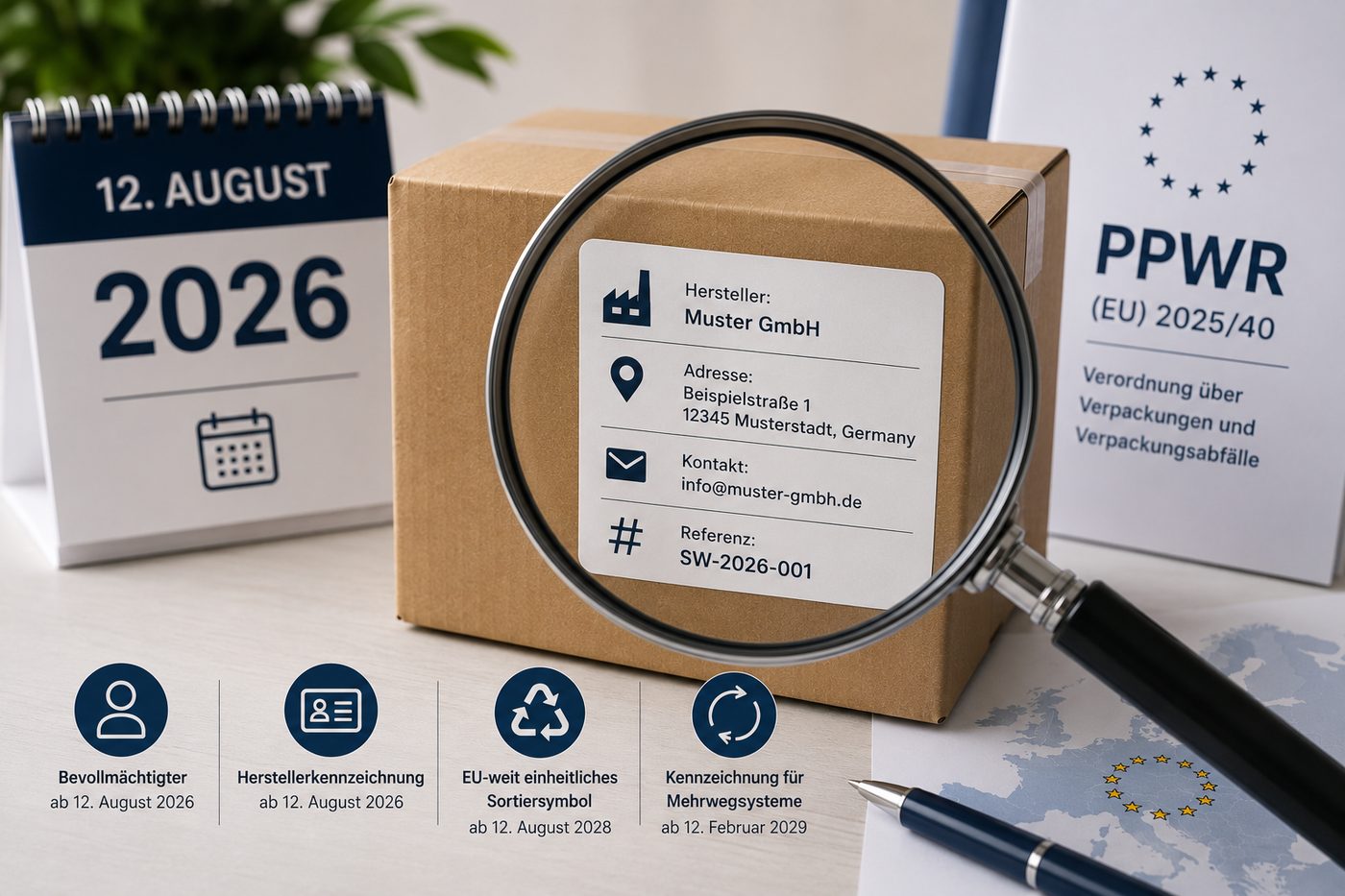
By Nadezda Walz, Packaging Compliance · Reading time: approx. 8 minutes · Updated: July 30, 2026
This article covers Germany specifically. On August 12, 2026, German packaging law changes significantly. Many companies selling goods into Germany are currently hearing two buzzwords: Authorised Representative (Bevollmächtigter) and labeling requirement. Both topics are frequently confused — and sometimes overdramatized — online. Note: while the underlying EU Packaging and Packaging Waste Regulation (PPWR) applies across all 27 EU member states, the specific national implementation, deadlines, and register described here (VerpackDG, LUCID, ZSVR) apply to Germany; other EU countries have their own national packaging registers and authorities, even though the EU-level rules are similar.
TL;DR: - From August 12, 2026, foreign companies without a German establishment that sell directly to German end consumers need a German Authorised Representative. - A new, EU-wide harmonized packaging label (the sorting symbol) does not arrive until 2028; the reusable-packaging label follows in 2029. Until then, only the identification feature, producer name/address (PPWR Art. 15) and a ban on misleading labeling (PPWR Art. 12(8)) apply. - Germany's VerpackG is being replaced by the VerpackDG; LUCID registration and the dual system obligations remain in place. - An EU Declaration of Conformity under PPWR Annex VIII becomes mandatory for every packaging item.
Sources for this article: the official text of Regulation (EU) 2025/40 (PPWR) on EUR-Lex, Germany's Packaging Act (VerpackG) on gesetze-im-internet.de, and the German Central Agency Packaging Register (ZSVR).
At a Glance
| August 12, 2026 — deadline for Authorised Representative & core duties | €200,000 — possible fine for non-compliance with VerpackG/VerpackDG | 27 — EU member states where the reciprocity principle applies |
| August 12, 2028 — earliest date for the EU sorting symbol | February 12, 2029 — earliest date for reusable-packaging labeling | 5 / 10 years — retention period for the Declaration of Conformity (single-use/reusable) |
Quick Test: Do You Need a German Authorised Representative?
- Do you have your own establishment (company, office, warehouse) in Germany?
- Yes → As a rule, you do not need an Authorised Representative, since you already count as a domestic producer.
- No → continue to the next question.
- Do you sell directly to German end consumers (B2C or B2B), e.g., via Amazon, your own shop, or eBay?
- Yes → From August 12, 2026, you need a German-based Authorised Representative.
- No, I only supply a reseller established in Germany → The producer obligation lies with the reseller/importer, not with you.
- Not sure who in your supply chain counts as the "producer"?
- Get your specific case reviewed — the classification depends on your exact distribution path.
Background: Germany's VerpackG becomes VerpackDG
Why the German law is changing now
Germany's existing Packaging Act (VerpackG) — with LUCID registration, dual-system participation, and the annual completeness declaration (Vollständigkeitserklärung) — is not being abolished, but adapted to the EU Packaging and Packaging Waste Regulation, PPWR (Regulation (EU) 2025/40). The PPWR already entered into force EU-wide on February 11, 2025, and applies directly in every member state from August 12, 2026 — meaning it does not need to be transposed into German national law first; it takes effect automatically.
From VerpackG to VerpackDG: what changes formally in Germany
To align enforcement, competent authorities, and sanctions in Germany with this directly applicable EU regulation, Germany is replacing the VerpackG with the Verpackungsrecht-Durchführungsgesetz (VerpackDG) — the German Packaging Law Implementation Act. The Bundesrat (German Federal Council) gave final approval to the draft in July 2026; the law is set to enter into force precisely on August 12, 2026.
In practice, this means: LUCID registration, dual-system participation, and the completeness declaration remain in place for Germany — but with stricter definitions, a broader scope, and two new obligations many companies aren't yet aware of.
1. The New Duty: Authorised Representative for Foreign Companies Selling into Germany
This is the most practically significant change for companies without a presence in Germany.
What applies from August 12, 2026
Foreign companies that count as a "producer" under German packaging law but have no establishment in Germany must appoint a German-based Authorised Representative. The legal basis is PPWR Art. 45(3) together with § 5(2) VerpackDG-E (draft). The Authorised Representative effectively takes on the company's EPR obligations toward the Central Agency Packaging Register (ZSVR) and German authorities.
Who is specifically affected?
Along with the deadline, the definition of who counts as a "producer" in Germany also changes:
- Going forward, as a rule, only the party that sells directly to the German end user counts as the producer in Germany — regardless of whether it's B2C or B2B, and regardless of whether it's through your own shop or a marketplace (Amazon, eBay, Etsy).
- If instead you sell to a reseller established in Germany, the producer obligation shifts automatically to that importer from August 12 — a deviating contractual arrangement between the parties will no longer be possible. The strict "domestic priority" principle leaves no room for flexibility here.
- This principle applies reciprocally across all 27 EU member states: whoever sells directly to end customers in another EU country automatically becomes the "producer" there and must appoint a local Authorised Representative in that country too.
Deadlines at a glance
| What | Deadline |
|---|---|
| Appointment of the Authorised Representative | by August 12, 2026 at the latest |
| Notification of the change to the packaging register for existing registrations | transition period until November 12, 2026 (based on § 6(1) sentence 2 VerpackDG-E) |
The caveat: a possible EU-wide suspension
In December 2025 the European Commission proposed suspending the obligation to appoint an authorised representative until 1 January 2035 — aimed mainly at producers established in another EU Member State. For producers from third countries (e.g. China, the USA, the UK), Member States are to remain free to require an authorised representative. The draft report in the European Parliament's Environment Committee would also limit the suspension to micro and small enterprises (up to 49 employees and €10 million annual turnover). The committee voted on 5 October 2026; the plenary vote is scheduled for 19 October 2026, followed by negotiations with the Council. Until an amendment is actually adopted, the obligation that has applied since 12 August 2026 stands — legal certainty comes only with adopted legislation, not with a proposal. (As of 10 October 2026)
2. Labeling Requirement: What Actually Happens on August 12 — and What Doesn't
This is where the most confusion exists in the market. Many service providers suggest that companies must completely relabel their packaging by the deadline. That's not accurate.
What does NOT happen on August 12, 2026
August 12, 2026 is the general date the PPWR becomes applicable and a deadline for the European Commission — not for companies. Two specific labeling obligations under PPWR Art. 12 are explicitly set for later:
- The EU-wide harmonized label for material composition (the new unified sorting symbol, which will replace the old national recycling codes under Decision 97/129/EC) takes effect at the earliest on August 12, 2028 — or 24 months after the relevant implementing acts enter into force, if those are delayed. As of June 2026, none of the three necessary implementing acts had been issued yet; only a non-binding technical proposal from the EU's Joint Research Centre (JRC), dated January 2026, is available. The symbol itself simply does not exist yet.
- The reusable-packaging label (Art. 12(2)) follows at the earliest on February 12, 2029.
Anyone trying to sell you a mandatory new pictogram for August 12, 2026 is misreading the regulation.
Timeline: All Labeling and Compliance Duties Compared
| Date | Duty | Legal Basis |
|---|---|---|
| Aug 12, 2026 | Authorised Representative for foreign direct sellers | PPWR Art. 45(3), § 5(2) VerpackDG-E |
| Aug 12, 2026 | Identification feature, producer name/address | PPWR Art. 15(5) |
| Aug 12, 2026 | Ban on misleading existing eco-claims | PPWR Art. 12(8) |
| Aug 12, 2026 | PFAS limits for food-contact packaging | PPWR Art. 5 |
| Nov 12, 2026 | Deadline to update existing LUCID registrations | § 6(1) sentence 2 VerpackDG-E |
| Dec 31, 2026 | End of transition period for old system participation | VerpackDG transitional rule |
| Oct 5, 2026 | First reading: possible suspension of Authorised Representative duty | European Parliament |
| Aug 12, 2028 | Harmonized EU sorting symbol (earliest) | PPWR Art. 12(6)-(7) |
| Feb 12, 2029 | Reusable-packaging labeling (earliest) | PPWR Art. 12(2) |
What IS actually mandatory FROM August 12, 2026
Two things do apply from the deadline — both independent of the future EU symbol, but stemming from different articles:
Ban on misleading labeling (PPWR Art. 12(8)): Economic operators may not apply labels, symbols, or markings that could mislead or confuse consumers about sustainability requirements, packaging characteristics, or waste management options. It's worth reviewing any existing "eco" claims on your packaging now.
Producer obligations (PPWR Art. 15(5)): Every unit of packaging must carry an identification feature (e.g., a type, batch, or serial number), plus the producer's (and, where relevant, importer's) name/brand, postal address, and electronic contact details.
- This information may be provided directly on the packaging, via a QR code, or — where physical application is not feasible — in accompanying documents.
- QR codes may not fully replace the mandatory information: certain details must still appear directly on the packaging itself.
- Language requirement: text-based information must be available in all languages of the markets where the product is sold — selling into Denmark means labeling in Danish.
- This information must be permanently affixed, clearly visible, and not easily removable.
- The obligation also applies to e-commerce shipping packaging; it does not apply to other purely transport packaging or deposit-system packaging (Art. 12(1)).
- Existing stock is protected: packaging produced or imported before the respective deadline may remain in circulation for up to three years after the relevant labeling requirement takes effect (Art. 12(12)).
What this means practically for your business
You don't need to overhaul your entire packaging design right now, and you don't need to wait for a new EU symbol to already be compliant — the symbol simply doesn't exist in 2026. But you should make sure now that producer name, contact details, and an identification feature are present, review existing eco-claims for misleading content — and keep an eye on the EU symbol's development through 2028 and the reusable-packaging label through 2029.
3. Other Changes Flying Under the Radar
- Expanded completeness declaration (Vollständigkeitserklärung): transport packaging will now be included in the audit, and all shipping packaging will become subject to mandatory system participation. This follows from the new catalog of packaging subject to system participation drawn up by the ZSVR — previous industry exemptions for individual sectors have been partially withdrawn as a result.
- PFAS limits for food-contact packaging: from August 12, 2026, packaging that comes into contact with food may contain certain PFAS only within narrow limits — a maximum of 25 ppb per individual substance and 250 ppb in total.
- Transitional rule for existing system participation: licenses under the old law generally remain valid at most until December 31, 2026 — unless otherwise agreed under private law. The waste management industry is already discussing that, due to the new, narrower producer definition, some companies will lose their system participation while others become newly obligated producers without yet realizing it.
Checklist: What You Should Do Now
- Re-assess your producer status. Do you sell directly to German end customers, or through a reseller? The answer determines, from August 12, who is responsible for the obligations.
- Appoint a German Authorised Representative if you sell directly to German end consumers without a German establishment — at the latest by the deadline.
- Update your existing LUCID registration or report the change by November 12, 2026.
- Check your packaging labeling: Are producer name, address, contact details, and an identification feature already present on or with the packaging? Add what's missing — without waiting for the 2028 EU symbol.
- Document conformity — see the template below.
- Keep an eye on developments regarding the possible suspension of the Authorised Representative requirement (EU Parliament reading on October 5, 2026), but don't rely on it in advance.
Template: EU Declaration of Conformity Under the PPWR
As a working aid, here is a simplified template for a Declaration of Conformity under PPWR Art. 15 in conjunction with Annex VIII, to be kept as part of the technical documentation.
EU DECLARATION OF CONFORMITY — PACKAGING pursuant to Regulation (EU) 2025/40 (PPWR), Art. 15 in conjunction with Annex VIII
1. Packaging / Declaration Identifier Number (matching the marking on the packaging): [e.g., PKG-2026-001] Date of declaration: [DD.MM.YYYY]
2. Producer (responsible party) Company name: [Company name] Address: [Street, no., postal code, city, country] Email: [email@example.com] URL (if applicable): [www.example.com]
3. Description of the Packaging Packaging type (sales / grouped / transport packaging): [e.g., sales packaging] Designation/model: [e.g., cardboard box 20×15×10 cm] Material: [e.g., corrugated cardboard, uncoated] Packaging supplier: [supplier name] Supporting supplier documentation: [e.g., material certificate no. … dated …]
4. Declaration of Conformity It is hereby declared that the packaging described above complies with the applicable requirements of the following provisions of Regulation (EU) 2025/40 (PPWR): 1. Art. 5 — restrictions on substances of concern 2. Art. 6 — minimization of packaging volume and weight 3. Art. 9–10 — recyclability requirements (recyclability performance grade) 4. Art. 11 — labeling for reusable packaging (if applicable) 5. Art. 15(5)–(6) — identification number and producer information on the packaging
The conformity assessment was carried out under the internal production control procedure (Module A, PPWR Annex VIII) based on the documentation referenced in Section 3.
5. Signature Place, date: [City, DD.MM.YYYY] Name, position: [First name Last name, position] Signature: ____
Note: This document is a working template for internal use, not an official EU form. The wording in Section 4 should be adapted to the actual set of requirements applicable to the specific type of packaging. Retention period: 5 years from placing on the market for single-use packaging, 10 years for reusable packaging — kept together with the technical documentation. This template does not substitute for legal advice.
Frequently Asked Questions About Germany's VerpackDG, Authorised Representative, and Labeling
Do I need to relabel my packaging by August 12, 2026? No. The harmonized EU label doesn't arrive until 2028 at the earliest. From August 12, 2026, only the identification feature, producer name/address (Art. 15), and the ban on misleading labeling (Art. 12(8)) are mandatory.
As a foreign Amazon seller, do I need a German Authorised Representative? Yes, if you sell directly to German end consumers without a German establishment — at the latest from August 12, 2026.
What happens if I don't appoint an Authorised Representative? Fines may apply, and in extreme cases a sales ban for the affected packaging in Germany; details are governed by the VerpackDG in conjunction with the PPWR's sanction provisions.
Does the VerpackDG replace LUCID registration? No. LUCID and dual-system participation remain in place — the VerpackDG merely aligns procedures, definitions, and competent authorities with the PPWR.
When does the new unified EU packaging symbol take effect? At the earliest on August 12, 2028, potentially later if the relevant EU implementing acts are delayed. For reusable-packaging labeling, the date is February 12, 2029.
Sources and Further Reading
- Regulation (EU) 2025/40 (PPWR) — official full text on EUR-Lex
- German Packaging Act (VerpackG) — legal text on gesetze-im-internet.de
- Central Agency Packaging Register (ZSVR) — official website
- LUCID Packaging Register — registration portal
Conclusion
August 12, 2026 brings less of a revolution and more of a tightening and clarification of existing obligations for Germany: a new Authorised Representative requirement for foreign direct sellers, a stricter producer definition, a ban on misleading labeling plus identification and address requirements under Art. 15, and a broader completeness declaration. The big, visible labeling reform with the EU-wide sorting symbol doesn't arrive until 2028, and reusable-packaging labeling not until 2029. Anyone who clarifies their producer status now, appoints an Authorised Representative, and gets their documentation in order will be prepared for every stage.
This article is for general informational purposes and does not constitute legal advice for individual cases. For a free initial assessment of your specific situation or support with LUCID registration and appointing an Authorised Representative in Germany, please contact us.
About the Author
Nadezda Walz advises Amazon sellers and online retailers on packaging compliance in Germany and across Europe (LUCID, EPR, VerpackG/VerpackDG). Before moving into consulting, she ran her own Amazon FBA business — giving her a seller's-eye view of these requirements, not just a theoretical, legal one.