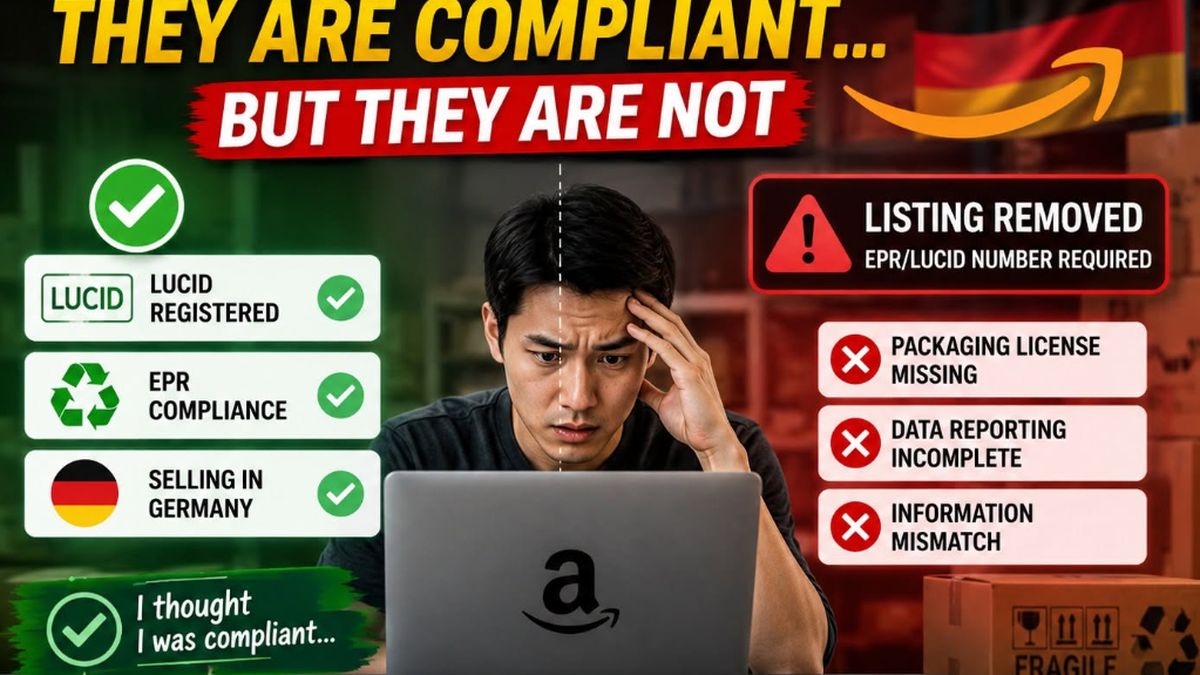
Many international Amazon sellers believe they are already compliant in Germany.
They have an Amazon account. They sell through FBA. They may have even entered an EPR number somewhere.
And yet Amazon can suddenly demand documentation, restrict listings, or deactivate products.
Why? Because many sellers don't fully understand what is actually required in Germany.
Germany checks more closely than many sellers expect
Germany has one of the stricter packaging systems in Europe. Anyone selling packaged goods to German end customers must, in many cases, deal with the Packaging Act. This includes not only large manufacturers, but also:
✅ Amazon FBA sellers
✅ Online retailers
✅ Private-label sellers
✅ International sellers
✅ Sellers based outside Germany
✅ Sellers who ship products to Germany
Official registration takes place through the LUCID packaging register (lucid.verpackungsregister.org). More information from the Central Agency Packaging Register: verpackungsregister.org.
Many sellers believe: "Amazon takes care of it"
This is one of the most common misconceptions.
Amazon provides the platform. Amazon can request certain EPR data. Amazon can point sellers to missing documentation. But responsibility for correct registration and fulfilling packaging obligations lies, in many cases, with the seller.
Amazon itself states that for packaging in Germany, the LUCID number is relevant as proof of compliance (Amazon EPR information).
Why sellers run into problems anyway
In practice, we increasingly see that international sellers only react once a problem is already visible. Typical situations:
✅ Amazon suddenly requests an EPR number
✅ a listing gets removed
✅ a product loses its selling authorization
✅ sellers receive a deadline to submit documentation
✅ the seller doesn't know which registration is meant
✅ the LUCID registration exists, but the packaging licence is missing
✅ the data at LUCID and at the licensing scheme don't match
The problem is often not just "no registration". The problem is frequently: the seller did something, but not completely or not correctly.
LUCID alone is often not enough
Many sellers think: "I have a LUCID number, so I'm done." That's dangerous. For packaging subject to system participation, registration alone is frequently not sufficient. In many cases, the seller additionally needs:
✅ Registration in the LUCID packaging register
✅ A packaging licence with a dual system
✅ Data reporting to LUCID
✅ Correct quantity figures
✅ Matching data between LUCID and the licensing scheme
✅ The correct number stored with Amazon
The Central Agency itself points out that data reporting is important and that the figures at LUCID and at the licensing scheme must match (Source: verpackungsregister.org).
Why this is especially difficult for international sellers
The Packaging Act is already complicated for German sellers. For international sellers, it's even harder, because several layers come together: German law, Amazon EPR requirements, LUCID registration, dual systems, packaging quantities, brand names, FBA structures, language barriers, and inaccurate information in forums.
A seller from China, the UK or the US can still be affected if their goods are sold to German end customers. What matters is not where the company is based — what matters is whether packaging ends up with an end customer in Germany.
The LUCID register is growing fast
This is no longer a niche topic. The Central Agency Packaging Register reported in 2024 that the LUCID packaging register had passed the 1 million registration mark (Source: verpackungsregister.org). Packaging compliance in Germany is no longer a small side issue — it's a central part of doing business for sellers, manufacturers and online retailers.
Amazon is getting better at detecting missing compliance
Marketplaces are becoming increasingly automated. Amazon can cross-check data, trigger warnings, detect missing numbers, and automatically restrict listings. AI-powered systems and automated compliance checks are also becoming more important.
In the past, an error could go unnoticed for a long time. Today, a missing or incorrect record can surface much faster. For sellers, this means: it's no longer enough to be "roughly compliant". The data needs to be correct, complete and traceable.
Common mistakes we see with Amazon sellers
Many problems come from small misunderstandings.
1. The seller registers with LUCID but forgets the packaging licence
LUCID is the registration. The packaging licence comes through a dual system. The two are often confused.
2. The wrong company gets registered
Sometimes a service provider, a brand, or the wrong legal entity ends up being registered. This can cause problems later when Amazon or business partners check the data.
3. The brand name is missing or spelled incorrectly
Brand names play an important role in the LUCID register. If brand details are missing or don't match the Amazon listings, this can lead to follow-up questions.
4. Quantities aren't reported correctly
Many sellers underestimate their packaging quantities. Others only report shipping cartons but forget product packaging or filling material.
5. Sellers think FBA automatically means compliance
FBA doesn't automatically resolve all packaging obligations. Even when Amazon stores and ships the product, the seller can still be responsible for certain packaging.
Why "I only sell a little" is not a safe assumption
Many small sellers believe: "I only sell a few products, this doesn't apply to me." But the Packaging Act doesn't have a general exemption just because a seller is small. Even small quantities can be relevant. That's exactly why smaller sellers should check early whether registration and licensing are required.
What can happen if sellers aren't compliant?
Possible consequences can include:
✅ Deactivation of listings
✅ Sales stop in Germany
✅ Request to submit documentation
✅ Issues with Amazon Account Health
✅ Legal risks
✅ Fines
✅ Distribution bans
Official ZSVR documents state that violations of Packaging Act obligations can constitute administrative offences, with fines of up to 200,000 euros possible (Source: ZSVR checklist, PDF).
Why many sellers react too late
The problem is psychologically understandable. As long as Amazon doesn't send a warning, everything feels normal. Products keep selling. The account works. Listings are online.
Then, suddenly, a message arrives: "EPR number required", "Listing removed", "Approval required", "Action required". Only then does the search for help begin. But that's exactly when the pressure is highest.
Better to check early than to fix it later
In our view, the most important advice is: don't wait until Amazon flags something. It's better to check early:
✅ Do I have a valid LUCID registration?
✅ Is the correct company registered?
✅ Are the correct brands registered?
✅ Do I have a packaging licence?
✅ Does the data at LUCID and the licensing scheme match?
✅ Is the correct EPR/LUCID number stored with Amazon?
✅ Are packaging quantities recorded realistically?
An early check is usually much easier than reacting later under time pressure.
More and more international sellers are seeking support
We're seeing more and more international sellers looking for support with German compliance topics. This most often involves: LUCID registration, packaging licences, Amazon EPR requirements, German Packaging Act compliance, uncertainty around Amazon notices, and questions about FBA and packaging obligations.
Many sellers don't want to read long legal texts. They simply want to know: what do I need to do so my Amazon business in Germany isn't put at unnecessary risk?
Conclusion: compliance isn't paperwork anymore — it's part of running an Amazon business
Many Amazon sellers believe they are compliant in Germany. But often, one important step is missing.
Maybe LUCID is in place, but the licence is missing. Maybe the licence is in place, but the data report isn't correct. Maybe everything is registered, but Amazon never received the correct number. Maybe the wrong company or brand was registered.
In a market where Amazon and regulators are relying more and more on data, automation and verification, a half-finished compliance status is no longer enough. Anyone selling in Germany should not treat LUCID, packaging licences and EPR as an afterthought. Because one small mistake can be enough to turn a listing into a problem.