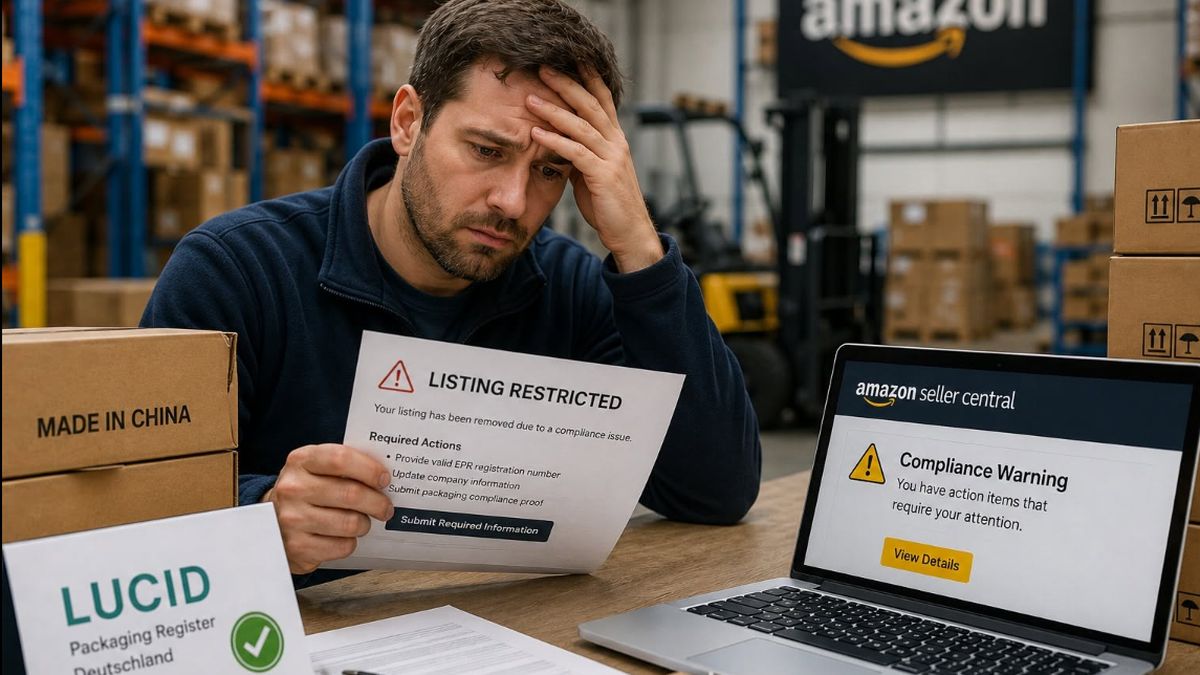
Many Amazon sellers believe their compliance problems are solved as soon as they've registered with LUCID.
In reality, many sellers continue to face: listing restrictions, compliance warnings, blocked ASINs, or requests for additional EPR information.
This causes a lot of confusion, because many businesses are genuinely convinced they've already done everything correctly. Here's why Amazon Germany listings can still be restricted even after LUCID registration — and what sellers should check right away.
Why this problem is becoming more common
Germany has significantly tightened environmental compliance enforcement in recent years. At the same time, marketplaces like Amazon have become much more active in verifying seller data and environmental registrations. Amazon officially states that sellers must provide EPR registration numbers for packaging, electronics, batteries, and other regulated categories.
As a result: more sellers are receiving compliance notifications, more ASINs are being restricted, and many businesses are discovering that registration alone often isn't enough.
The biggest misconception: "But I already have LUCID"
This is probably the most common reaction from sellers. Many businesses think: "I registered with LUCID, so I'm compliant." But in Germany, LUCID registration is often just one part of the system.
In many cases, sellers also need:
✅ Participation in a dual system
✅ Packaging licensing
✅ Correct company data
✅ Matching marketplace information
✅ Proper packaging reporting
Official LUCID information explains that companies placing packaging on the German market must register and participate in a packaging recycling system.
Why listings can still get restricted
Below are some of the most common reasons Amazon Germany sellers keep running into problems despite being registered.
| Common issue | What happens |
|---|---|
| Seller only registered with LUCID | Amazon can still require a dual system |
| Company name doesn't match | Amazon can't correctly verify the registration |
| Incorrect marketplace data | EPR data fails validation |
| Packaging quantities not reported | Compliance looks incomplete |
| Wrong number uploaded | Amazon can't match the registration |
| Delay in Amazon verification | Listings stay restricted temporarily |
| Seller misunderstands obligations | Wrong EPR category used |
This happens especially often with international sellers who aren't familiar with Germany's compliance systems.
Amazon verification doesn't always happen instantly
Another major source of confusion is timing. Many sellers expect immediate approval, immediate ASIN restoration, and automatic compliance checking.
But Amazon's verification systems often take time. Sometimes sellers upload correct information, yet restrictions remain temporarily in place, or Amazon requests additional documentation later.
This causes panic, because businesses think: "Amazon ignored my registration." In reality, the problem is often just a delayed sync or an incomplete verification.
International sellers often face extra challenges
International sellers usually have more compliance difficulties than German businesses, because they're dealing with unfamiliar laws, German technical terminology, multiple compliance systems, internal Amazon processes, and language barriers all at once.
Many sellers also don't understand the difference between: LUCID registration, packaging licensing, dual systems, WEEE, battery registration, and EPR itself. This confusion frequently leads to unintentional mistakes.
Amazon FBA adds to the confusion
Many FBA sellers think: "Amazon handles everything." But packaging compliance obligations in Germany remain with the seller — even when Amazon stores and ships the products through FBA.
Using Amazon FBA does not transfer German packaging compliance obligations to Amazon. This misunderstanding is one of the main reasons international sellers later receive unexpected EPR notices and listing restrictions.
Which sellers are most at risk
The following groups run into compliance problems especially often:
| Seller type | Typical risk |
|---|---|
| New Amazon Germany sellers | Limited understanding of German compliance |
| International sellers | Language and legal confusion |
| FBA sellers | Assume Amazon handles everything |
| Fast-growing sellers | Packaging reporting becomes complex |
| Sellers with many ASINs | Higher risk during verification |
| Multi-marketplace sellers | Inconsistent data |
Small sellers are not automatically protected just because their sales volume is low.
Why Amazon has become significantly stricter
Germany increasingly expects marketplaces to actively enforce compliance rules. Amazon has therefore become much more proactive about requesting registration numbers, verifying seller data, restricting non-compliant listings, and preventing regulated sales without valid information.
As a result, operational risks now appear much earlier than they did just a few years ago.
Typical warning signs before listing restrictions
Many sellers notice warning signs before actual restrictions happen. Typical examples:
✅ Amazon emails with EPR requests
✅ Notices in Seller Central
✅ Compliance warnings at the ASIN level
✅ Requests to update registration data
✅ Category restrictions
✅ "At risk" notifications
Ignoring these warnings often leads to bigger problems later.
What sellers should check right away
If listings get restricted — or Amazon requests EPR information — sellers should typically check the following:
| Check | Why it matters |
|---|---|
| Is the LUCID number correct? | Incorrect IDs fail verification |
| Does the company name match exactly? | Amazon cross-checks registration data |
| Is a dual system active? | LUCID alone is often not enough |
| Has packaging reporting been filed? | Missing reports can cause problems |
| Is the correct EPR category being used? | Different products need different registrations |
| Was the data uploaded correctly to Amazon? | Formatting errors are common |
Many sellers find the problem is smaller than they originally feared.
Why some sellers panic unnecessarily
It's important to understand: a compliance notification does not automatically mean a disaster, an account suspension, or immediate fines.
In many cases, the problem can be fixed, the registration already exists, or Amazon simply needs additional verification. The worst response is usually to ignore the situation entirely.
Estimated compliance costs by seller size
Many sellers overestimate the cost of packaging compliance. Example ranges:
| Seller size | Typical packaging licensing cost |
|---|---|
| Small seller | €50–€250/year |
| Growing seller | €300–€1,500/year |
| Larger businesses | Several thousand euros/year |
Plastic packaging is usually more expensive than paper or glass, since recycling fees for plastic tend to be higher. The bigger challenge, though, is usually understanding the obligations, calculating packaging correctly, and staying compliant long-term.
Why more sellers are seeking help
Many businesses only realize how complex Germany's compliance systems really are after receiving an Amazon notification. That's why more and more sellers are looking for: EPR consulting, LUCID support, Amazon Germany compliance support, help with packaging reporting, and dual system guidance.
International sellers selling in Europe for the first time especially need this kind of support.
Conclusion
Many Amazon Germany sellers don't lose listings because they deliberately break the rules — they lose them because they misunderstood the compliance system.
The most common mistake is believing: "LUCID registration alone is enough." In reality, compliance often involves multiple systems, correct data synchronization, packaging licensing, reporting, and marketplace verification.
The earlier sellers understand this, the easier it becomes to avoid stressful listing restrictions later on.
Official sources
LUCID packaging register: lucid.verpackungsregister.org
Amazon Germany EPR information: sell.amazon.de
Packaging Act information: verpackungsregister.org