"Wait. Are you saying we need all this data even for an ordinary cardboard box?"
That's the question more and more sellers are asking when they first run into the new European PPWR regulation. And it's a completely fair question.
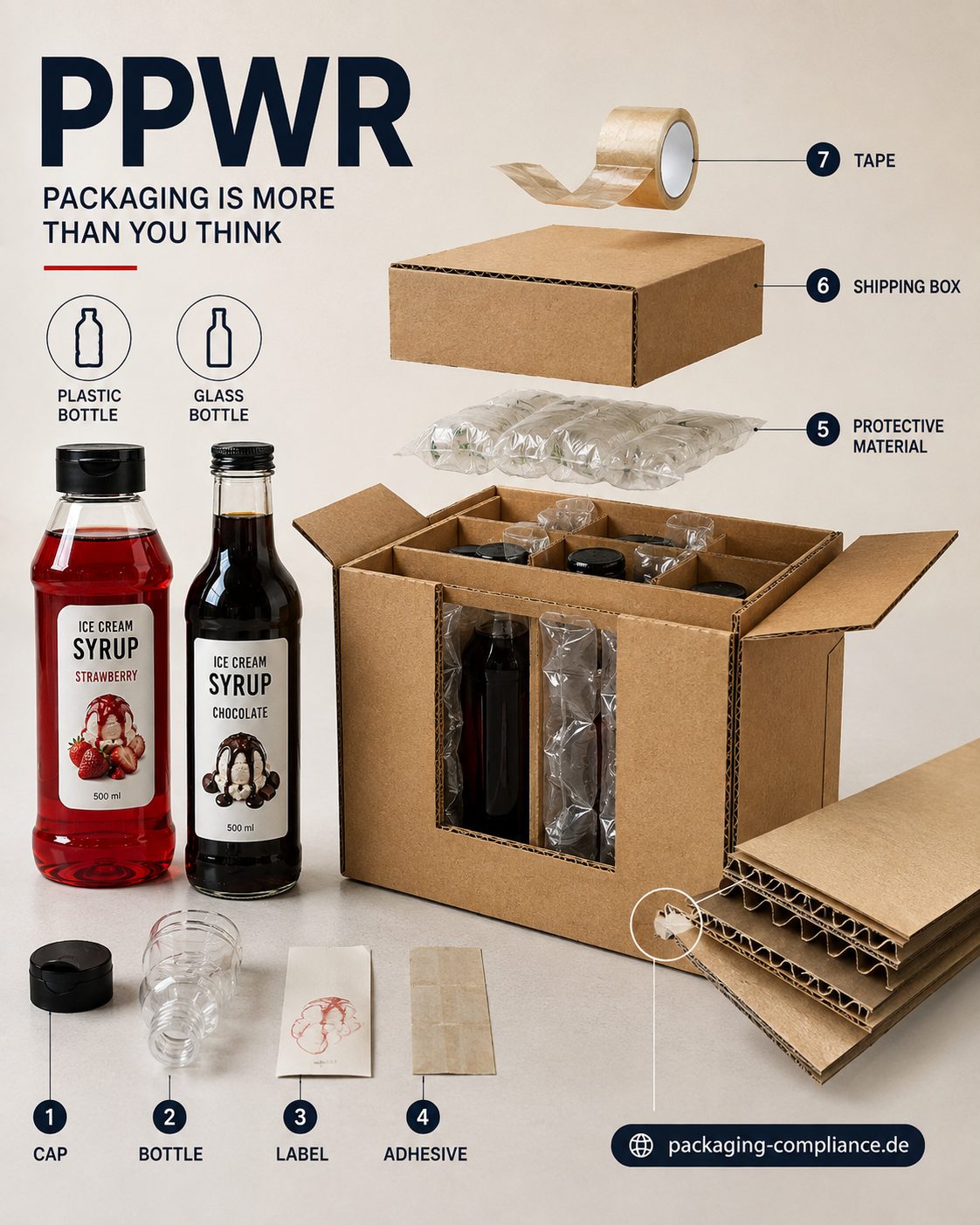
A business owner looks at their product and sees a simple picture: syrup → bottle → box → Amazon. But once the actual packaging analysis begins, the picture gets a lot more complicated: bottle → cap → label → adhesive → protective material → shipping box → tape.
And that's where the central question comes in: does all of that really need to be accounted for?
In this article we walk through a practical case: a seller of ice cream syrup shipping to Amazon FBA Germany. Part of the range comes in glass bottles, part in plastic. The packaging is manufactured in China. And when the Chinese supplier received the first PPWR request, they could only provide part of the required information.
This is a very typical situation for smaller European sellers. In practice, the real PPWR problem is rarely about reading the regulation text. The problem is getting concrete technical data on the concrete packaging from the manufacturer — ideally before thousands of units have already been produced.
What PPWR Means in Plain Terms
PPWR is the new EU-wide Regulation (EU) 2025/40 on packaging and packaging waste. It entered into force in February 2025 and has applied on a phased basis since 12 August 2026 — confirmed by the European Commission's official announcement of 11 August 2026, which specifically names the PFAS restriction on food-contact packaging as one of the measures entering into application on exactly that date.
There's an important difference here from the LUCID or EPR registration sellers are used to. PPWR isn't just a registration and it isn't just a volume report. It's requirements on the packaging itself and on proof of its conformity. So the first question shouldn't be "how do I get a PPWR declaration," but "what does my packaging actually consist of, and which requirements apply to it?"
Important not to confuse the two: the PPWR declaration does not replace LUCID registration and dual-system participation — these are two parallel, independent requirements. A seller shipping packaged goods to Germany has to handle both at the same time: register with LUCID and pay the packaging licence (the older German system) — and separately prepare a PPWR declaration of conformity (the new EU-wide requirement on the design and material composition of the packaging itself). Having one document does not remove the need for the other.
The Client's Product, Component by Component
Our client sells ice cream syrup — strawberry, chocolate, caramel, fruit syrups. Fill sizes from 250 ml to 1 litre. Two main packaging configurations are used: glass bottle and plastic bottle. Let's look at the product the way a packaging specialist would — layer by layer.
Layer 1 — the bottle. This is the primary consumer packaging. Glass for one variant, plastic for the other. Even here, exact material, weight, composition, and relevant documentation need to be established. "It's a plastic bottle" isn't enough — the conformity assessment needs to know exactly which material it is.
Layer 2 — the cap. The cap can be made of a completely different material from the bottle itself. It can't simply be bundled into "plastic bottle" — material and properties need to be determined separately.
Layer 3 — the label. It consists of paper or a plastic substrate, printing inks, coating, adhesive. "Does all of that really matter?" — depending on the specific requirement, yes, packaging components can be relevant. PPWR explicitly looks not just at packaging as a whole but at its components too: Article 5 sets limits on certain substances in packaging or its components.
Layer 4 — protective material. Glass bottles get extra protection in transit — air cushions, film, cardboard dividers. What needs clarifying: which material, what weight, does it function as packaging in this specific case, and which PPWR requirements apply to it? You shouldn't assume every small scrap of material automatically needs its own declaration — but you can't ignore it just because it's small, either.
Layer 5 — the shipping carton. The bottles go into a box that heads to the Amazon FBA warehouse in Germany. "But the customer never even sees this box" — that doesn't automatically mean the box falls outside PPWR's scope. The regulation applies to packaging regardless of material and sets out its own categories, including transport packaging.
Layer 6 — the tape. The box gets sealed with packing tape. "Seriously? The tape too?" — you shouldn't swing to the other extreme and turn PPWR into a list of a thousand individual declarations. But materials can't just be dropped from the analysis without reason: the heavy-metal limit applies specifically to packaging and its components, adhesives included.
Heavy Metals: Genuinely Covers Everything
Article 5 of the regulation sets a limit on the combined sum of lead, cadmium, mercury, and hexavalent chromium in packaging or its components — the limit is 100 mg/kg. The key word is "components": the limit doesn't apply only to the bottle's primary material, but to every element listed at once — glass, plastic, the cap, the printing ink on the label, the adhesive in the tape.
For this requirement, a written confirmation from the material supplier is almost always enough — a separate lab test isn't needed unless it's an unusual material with unusual additives or pigments.
PFAS: Glass and Plastic Are Two Completely Different Stories Here
Syrup is a liquid food product in direct contact with the inside surface of the bottle. That triggers a separate, much stricter requirement specifically for the bottle: the PFAS ("forever chemicals") restriction for food-contact packaging. The limits set by the regulation: 25 ppb per individual PFAS substance, 250 ppb combined, 50 ppm total fluorine including polymeric PFAS.
Here a written assurance from the supplier is not enough — what you need are laboratory analysis results for this specific packaging.
A practical technical detail that genuinely saves money in this case: the PFAS risk isn't the same for glass and plastic. For glass bottles, the risk is essentially zero — glass is chemically inert. For plastic bottles (especially HDPE and PP), there's a concrete, documented source of risk: fluorination, an industrial treatment with fluorine used to improve the plastic's barrier properties against liquid penetration. Investigations by the US Environmental Protection Agency confirm that this process unintentionally generates PFAS compounds, which can then migrate into the bottle's contents.
The right technical question to ask a plastic-bottle supplier, then, isn't "is your bottle food-safe?" but specifically: "was a fluorination treatment applied to this plastic container at any stage of production?" That doesn't mean every plastic automatically contains PFAS — that conclusion would be wrong. Plastic packaging simply means the requirement needs checking; everything after that depends on the specific material and manufacturing process.
The regulation allows a tiered testing approach: start with a cheap total-fluorine screening for a few hundred euros. If the result comes back under 50 ppm, that's enough — no further testing needed. Only if the first test comes back above that threshold is the more expensive targeted substance analysis (LC-MS/MS) required.
A critical point on timing: accredited labs in the EU are currently overloaded, and PFAS testing takes 8–14 weeks. If a product is already on sale and testing hasn't been commissioned yet, that's not a theoretical risk — it's a real time problem.
Glass and Plastic Are Not the Same Packaging
Materials differ, construction can differ, suppliers can differ. You can't treat them as the same packaging just because the same syrup is inside — the assessment needs to be done separately for each configuration. That said, there's no need to create a separate document for every syrup colour or every label as long as the packaging is factually identical and the difference doesn't change the assessment result. That's exactly why the number of declarations can't be determined by the simple rule "one product = one declaration."
And What If the Supplier in China Doesn't Understand What's Being Asked
That's exactly what happened in this case. It's not down to any lack of diligence on the supplier's part — the regulation really is brand new, specific to the EU market, and Chinese manufacturers geared toward the global market simply haven't had a reason to study it in detail yet.
You send the request: "Please confirm your packaging complies with EU requirements." The answer comes back: "Yes, recyclable." "Food grade." "EU standard." "We have certificate." The seller thinks: great, all sorted. No — on their own, these answers say almost nothing about the specific PPWR requirement. Which material? Which component? Which limit? Which test method? Which lab? Which specific packaging was actually tested — these are the questions that actually matter.
A certificate for one material doesn't mean the whole packaging is compliant: the supplier shows a certificate for the plastic bottle, but the cap might come from a different supplier, the label might use a different adhesive, and the shipping carton might be produced by a third party. You need to understand the scope of each document.
Ready-Made Supplier Request Template — With Language Switching and Copy
Instead of a general request, a concrete, itemised list works better: material → requirement → limit → evidence. Below is a ready working template in three languages. Most packaging suppliers in Asia respond faster in English or Chinese than to German correspondence or machine translation.
Request to your packaging supplier
Copy the text and send it to your supplier. It asks for exactly what's needed for the declaration of conformity.
Tip: most packaging manufacturers in Asia respond faster in English or Chinese. The request with explanations is also on its own page: Supplier request for the PPWR declaration.
What to Do If the Supplier Still Doesn't Deliver
First — sharpen the request. Very often the problem isn't a lack of data, it's that the supplier simply didn't understand what exactly was being asked. A concrete list of components and requirements (as above) resolves most cases.
Second — ask for technical documentation that already exists: material specifications, manufacturer documents, test results, confirmations from raw-material suppliers.
Third — if the data genuinely doesn't exist, assess whether independent testing is needed. But don't automatically send the entire packaging off to a lab — first work out which requirement needs proving and which material is actually the source of risk. Otherwise you can easily spend thousands of euros on analyses that were never actually necessary.
The Shipping Carton to the Amazon FBA Warehouse: No B2B Exemption
It's important here not to confuse two different shipping legs — they have different responsible parties.
Leg 1 — the seller ships the batch to the warehouse. The seller (or their supplier, acting on the seller's order) packs several bottles into a bulk carton and ships it to the Amazon FBA warehouse in Germany. The seller selects and orders this box — it never physically reaches the end customer, and is opened at the warehouse. Many sellers familiar with Germany's LUCID system wrongly assume such a box is exempt from the requirements precisely because the customer doesn't see it — the way purely B2B packaging typically works under the German financial-participation system. That assumption doesn't hold for the PPWR declaration: the European Commission's official FAQ confirms there is no B2B exemption from the declaration obligation — transport packaging falls within scope just as much as sales packaging. Responsibility for this specific box stays with the seller.
Leg 2 — Amazon packs the order for the customer. When the customer places an order, Amazon itself picks the item from the warehouse and packs it into its own branded box — with Amazon's own logo, Amazon's own tape, Amazon's own air cushions. The same principle applies here as for every other layer: responsibility sits with whoever selects and orders the specific material under their own name. This final packaging is selected and ordered by Amazon, not the seller — so responsibility for it sits with Amazon.
Five Questions to Ask a Supplier Before the Next Order
- What material is each packaging component made of?
- What is the exact weight of each component?
- What technical documentation exists for these materials?
- What tests have already been carried out, and by whom?
- Does the document being provided actually refer to the exact packaging now being ordered?
If a supplier can't answer even these basic questions, that's already a reason to pause and dig deeper — before placing the order.
The Most Expensive Mistake: Finding Out After Production
Picture this: 10,000 bottles are ordered, production is finished, payment has been made, the goods are sitting in China. And only then does it turn out the required documentation doesn't exist. Now you're looking at extra testing, delivery delays, packaging changes, a new batch, repacking, added logistics costs, a delayed market launch, lost sales. If the problem is only discovered after the goods have already arrived in the EU, the mistake is even more expensive. The cheapest moment to check packaging is therefore before production, not after.
Bottom Line
If you sell in Europe, don't start with "where do I download a PPWR template." Start with this instead: what packaging is actually used for my product? Break it down into components. Identify the materials. Get information from suppliers. Determine the applicable requirements. Gather evidence. Only then draw up the declaration of conformity.
Your supplier may not know European law. But they do know what their bottle is made of, how much it weighs, which manufacturing process is used, which adhesive and which label are involved. Your job is to ask them the right questions.
Exactly this kind of practical situation is what led us to build our own PPWR declaration generator and label generator — tools that help you get from the actual packaging to a finished document, instead of just handing you one more template.
Note: This article is for general informational purposes and does not constitute legal advice. Your specific obligations depend on your product, your packaging, and your business model. For a binding assessment, consult a qualified professional.
Official Sources
- Regulation (EU) 2025/40 — PPWR, full text (EUR-Lex)
- European Commission — Packaging and Packaging Waste
- Official PPWR FAQ (published 3 August 2026)
- European Commission — on PPWR entering into application on 12 August 2026
- US EPA — materials on PFAS and fluorinated plastic packaging