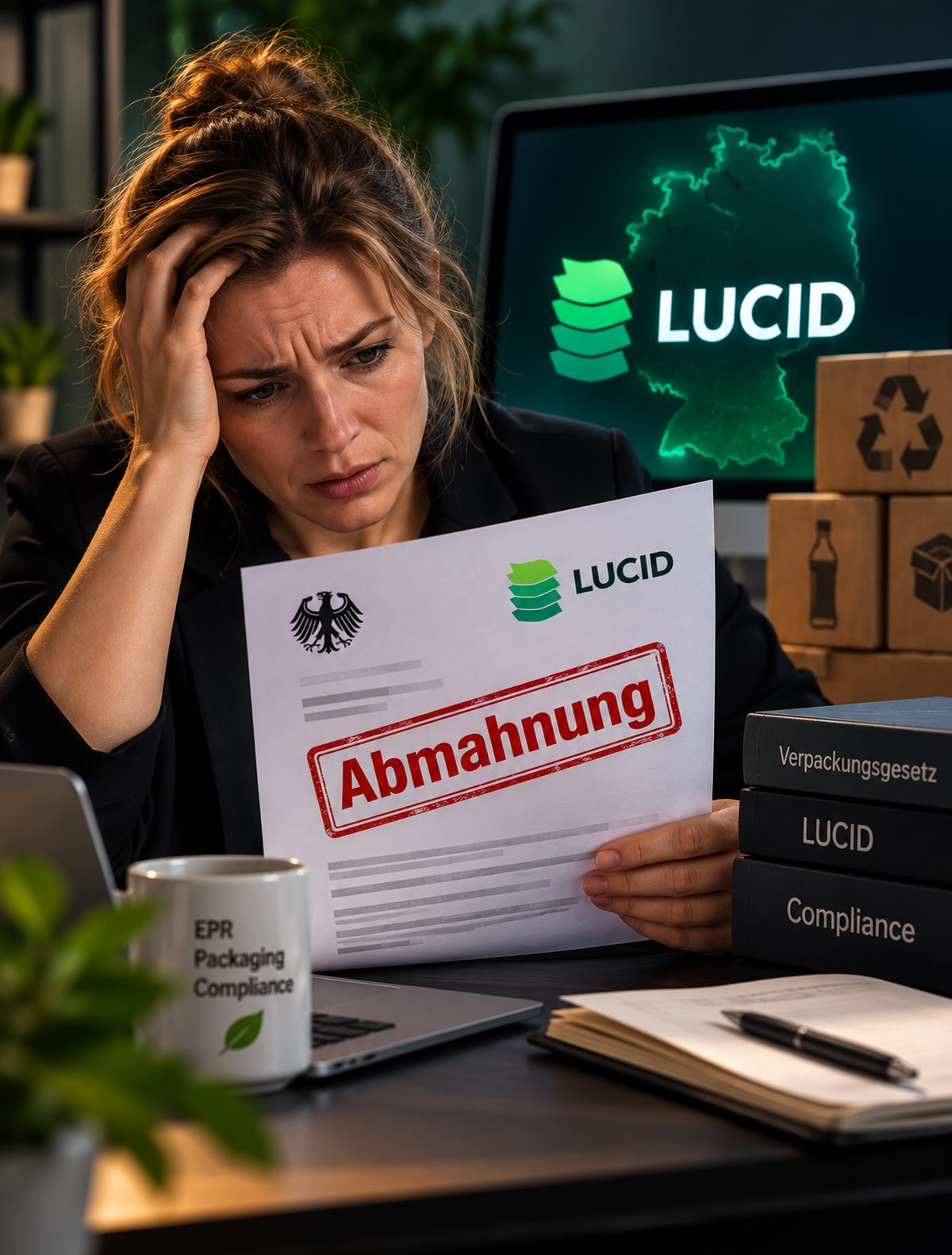
The warning letter arrives by post or email, from a law firm you've never heard of, on behalf of a competitor you may not know either. The claim: you're selling packaged goods in Germany but are not registered in the LUCID packaging register, or not enrolled with a dual system. Enclosed: a cease-and-desist declaration to sign, and an invoice for several hundred euros. Deadline: two weeks.
This is the most common way violations of the German Packaging Act are "punished" – not by authorities, but by competitors. This article explains what's behind it, what you should do, and how to avoid getting one in the first place.
Why competitors are allowed to send warning letters
The Packaging Act obliges everyone who places packaged goods on the German market to register in LUCID and join a dual system. Anyone who skips this saves money and effort – and, under established case law, gains an unfair competitive advantage (Section 3a UWG, "breach of law"). That is exactly what gives competitors and entitled associations the right to demand a cease-and-desist.
The ZSVR publishes the register openly. A competitor (or a law firm specialising in this) only needs to enter your company name. If there's no entry, a warning letter can be prepared within minutes.
What a warning letter costs
| Item | Typical amount | When due |
|---|---|---|
| Claimant's lawyer fees | approx. €500–1,500 | immediately, if the warning is justified |
| Contractual penalty | €3,000–5,000 per violation | only on a repeat violation after signing |
| Your own lawyer (optional) | €200–800 | for review and a modified declaration |
| Back-licensing with the dual system | depending on volumes, retroactive | due regardless |
| ZSVR fine (independent of this) | up to €100,000 / €200,000 (Section 36 VerpackG) | in a regulatory proceeding |
For comparison: the packaging licence itself costs a small seller €25–150 a year. A single warning letter costs ten times that.
Received a warning letter: five steps
1. Don't ignore it, note the deadline
Anyone who doesn't respond usually receives an interim injunction from the court – at significantly higher cost. Note the deadline set (typically 7–14 days). A reasoned request for an extension is often granted.
2. Check whether it's justified
Is the claimant really a competitor (comparable goods, same market)? Is the accusation accurate – is registration really missing, or was it just done under a different company name? Is the law firm genuine? In rare cases warning letters are abusive (serial warnings with no real competitive interest) – then there is no claim to cost reimbursement.
3. Register and license immediately
Regardless of everything else: register in LUCID (free, done in a day) and complete system participation – retroactively for the current year. This removes the violation and is the basis for any further negotiation. We guide you through it – initial consultation from €99 if it needs to happen fast.
4. Don't sign the cease-and-desist declaration unreviewed
The enclosed declaration is drafted by the other side – usually too broad, with a high contractual penalty. A modified cease-and-desist declaration is common: you acknowledge the obligation, but with a reasonable penalty (e.g. determined by the court under the "Hamburg practice") and without acknowledging the cost amount. A lawyer specialising in competition law is worth it here – the declaration binds you for 30 years.
5. Check the cost invoice
The value in dispute set determines the lawyer fees. €10,000–15,000 is common for small sellers; €30,000 or more is contestable. Warning-letter costs only have to be reimbursed if the warning is justified.
Typical triggers
– Foreign Amazon sellers who have never heard of LUCID – since 12 Aug 2026 also without an authorised representative.
– Registered but not licensed: a LUCID number exists, but system participation is missing. Visible in the register.
– Missing brand name: you sell under a brand not recorded in LUCID – to the claimant this looks like an unregistered producer.
– Dropshipping and private label: "the supplier handles it" – usually they don't.
– Forgotten shipping packaging: product packaging licensed, shipping box and cushioning not.
Avoiding a warning letter: the checklist
1. LUCID registration before your first sale – free, 20 minutes.
2. Complete system participation with a dual system and record the number in LUCID.
3. Enter all brand names you sell under in LUCID.
4. Report volumes annually (deadline: 15 May for the prior year).
5. Keep the company name identical across LUCID, your imprint and marketplace account.
6. Without a German establishment: appoint an authorised representative and have it confirmed in LUCID.
7. Check your own entry in the public LUCID register once a year – the way a competitor would.
FAQ
Who can send me a warning letter for missing LUCID registration?
Competitors – i.e. sellers offering comparable goods to the same target group – as well as trade associations and consumer bodies entitled to sue. The ZSVR itself does not send warning letters; it can impose fines and require marketplaces to block listings.
How much does a warning letter for the Packaging Act cost?
The claimant's lawyer fees depend on the value in dispute, usually set between €10,000 and €30,000 for Packaging Act violations. That results in warning-letter costs of roughly €500 to €1,500. On repeat violation, a contractual penalty from the cease-and-desist declaration is added – typically €3,000 to €5,000 per violation.
Is a warning letter justified if I'm simply not registered?
Usually yes. Under established case law, the registration and system-participation obligation of the Packaging Act counts as a market-conduct rule under Section 3a UWG (Germany's unfair competition law). Selling without registration gives you an unfair advantage – enough grounds for a warning letter.
Do I have to sign the enclosed cease-and-desist declaration?
Not in the pre-drafted form. You should generally acknowledge the obligation to stop, but have the wording, scope and amount of the contractual penalty reviewed – they are often drafted too broadly. A modified cease-and-desist declaration is common and acceptable. Not responding at all almost always leads to an interim injunction.
How quickly do I have to respond?
Warning letters typically set deadlines of 7 to 14 days. Within that time you should register in LUCID, complete system participation and decide on the cease-and-desist declaration. Extensions are often granted if requested with reasons.
Can I resolve the warning letter by registering afterwards?
Registration removes the violation going forward but not the risk of repetition. Legally, that risk is only removed by a cease-and-desist declaration with a contractual penalty attached. Register immediately anyway – it's the basis for everything that follows and reduces the risk of further warning letters.
What fines can the ZSVR impose in addition?
Independently of the warning letter, the ZSVR can impose fines: up to €100,000 for missing registration and up to €200,000 for missing system participation (Section 36 VerpackG). In practice amounts for small sellers are usually far lower, but the procedures are unpleasant and time-consuming.
This article is for general information only and does not constitute legal advice. For a specific warning letter, consult a lawyer specialising in competition law. Cost figures are typical ranges, as of September 2026.