Create a PPWR Declaration of Conformity: Fill Out 1 Form, Get All 27 EU Countries at No Extra Cost
Fill out the form — every field explains what it means and where to get the information. The preview updates automatically. More background: our Q&A guide, or the full PPWR compliance guide for online sellers.
Read more
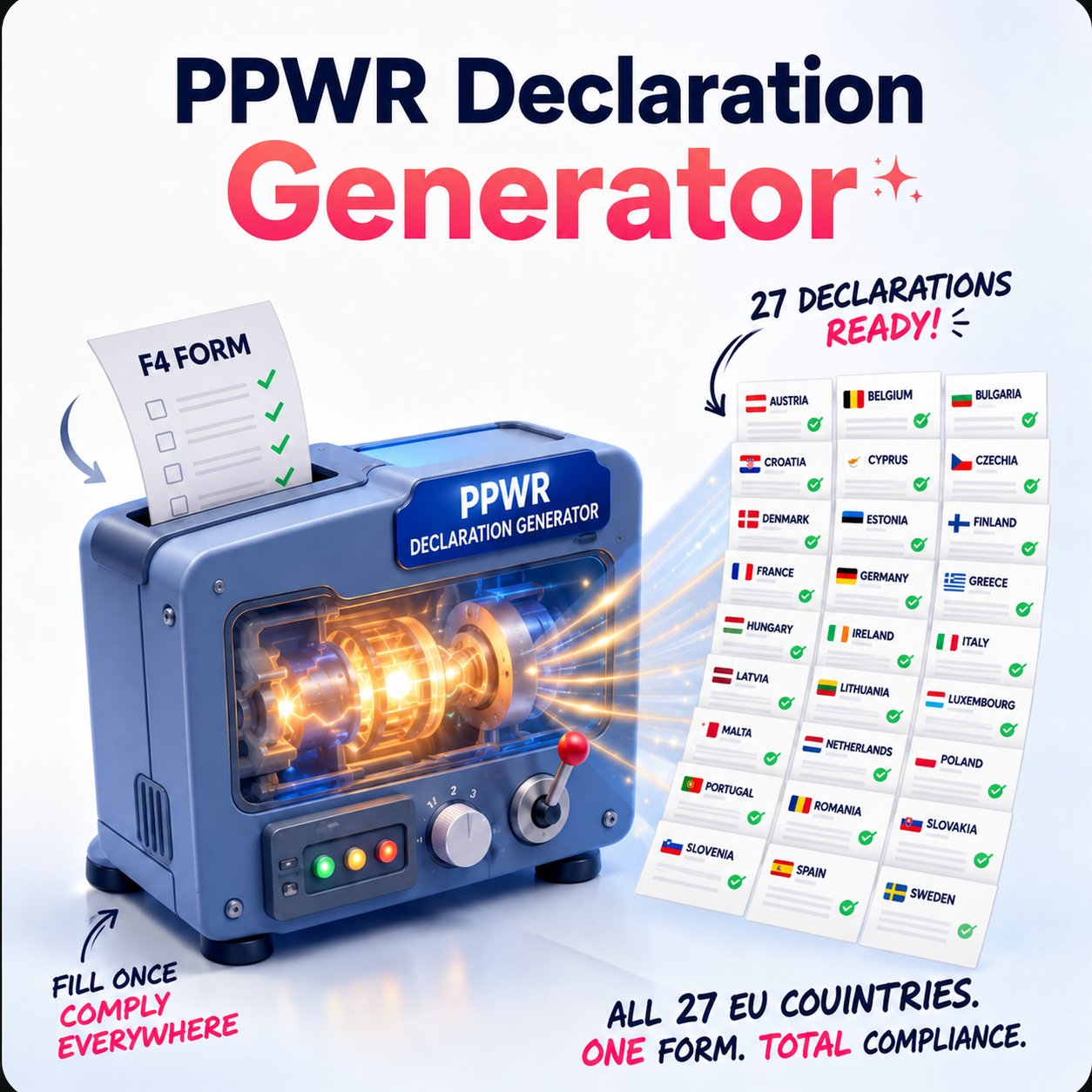
Declarations for all 27 EU countries, each in its official language
Included in every plan.
- Austria
- Belgium
- Bulgaria
- Croatia
- Cyprus
- Czechia
- Denmark
- Estonia
- Finland
- France
- Germany
- Greece
- Hungary
- Ireland
- Italy
- Latvia
- Lithuania
- Luxembourg
- Malta
- Netherlands
- Poland
- Portugal
- Romania
- Slovakia
- Slovenia
- Spain
- Sweden
Show the declaration title for each country
This is the title your declaration carries in the PDF, for example in Latvian for Latvia and in Bulgarian for Bulgaria:
- AustriaGermanEU-KONFORMITÄTSERKLÄRUNG (VERPACKUNG)
- BelgiumDutchEU-CONFORMITEITSVERKLARING (VERPAKKING)
- BulgariaBulgarianЕС ДЕКЛАРАЦИЯ ЗА СЪОТВЕТСТВИЕ (ОПАКОВКА)
- CroatiaCroatianEU IZJAVA O SUKLADNOSTI (AMBALAŽA)
- CyprusGreekΔΗΛΩΣΗ ΣΥΜΜΟΡΦΩΣΗΣ ΕΕ (ΣΥΣΚΕΥΑΣΙΑ)
- CzechiaCzechEU PROHLÁŠENÍ O SHODĚ (OBALY)
- DenmarkDanishEU-OVERENSSTEMMELSESERKLÆRING (EMBALLAGE)
- EstoniaEstonianEL-I VASTAVUSDEKLARATSIOON (PAKEND)
- FinlandFinnishEU-VAATIMUSTENMUKAISUUSVAKUUTUS (PAKKAUS)
- FranceFrenchDÉCLARATION UE DE CONFORMITÉ (EMBALLAGE)
- GermanyGermanEU-KONFORMITÄTSERKLÄRUNG (VERPACKUNG)
- GreeceGreekΔΗΛΩΣΗ ΣΥΜΜΟΡΦΩΣΗΣ ΕΕ (ΣΥΣΚΕΥΑΣΙΑ)
- HungaryHungarianEU-MEGFELELŐSÉGI NYILATKOZAT (CSOMAGOLÁS)
- IrelandEnglishEU DECLARATION OF CONFORMITY (PACKAGING)
- ItalyItalianDICHIARAZIONE DI CONFORMITÀ UE (IMBALLAGGIO)
- LatviaLatvianES ATBILSTĪBAS DEKLARĀCIJA (IEPAKOJUMS)
- LithuaniaLithuanianES ATITIKTIES DEKLARACIJA (PAKUOTĖ)
- LuxembourgFrenchDÉCLARATION UE DE CONFORMITÉ (EMBALLAGE)
- MaltaEnglishEU DECLARATION OF CONFORMITY (PACKAGING)
- NetherlandsDutchEU-CONFORMITEITSVERKLARING (VERPAKKING)
- PolandPolishDEKLARACJA ZGODNOŚCI UE (OPAKOWANIE)
- PortugalPortugueseDECLARAÇÃO DE CONFORMIDADE UE (EMBALAGEM)
- RomaniaRomanianDECLARAȚIA DE CONFORMITATE UE (AMBALAJE)
- SlovakiaSlovakEÚ VYHLÁSENIE O ZHODE (OBAL)
- SloveniaSlovenianIZJAVA EU O SKLADNOSTI (EMBALAŽA)
- SpainSpanishDECLARACIÓN UE DE CONFORMIDAD (ENVASE)
- SwedenSwedishEU-FÖRSÄKRAN OM ÖVERENSSTÄMMELSE (FÖRPACKNING)
What is a PPWR Declaration of Conformity?
A PPWR Declaration of Conformity (officially the EU Declaration of Conformity for packaging, sometimes shortened to PPWR DoC) is the manufacturer's written self-declaration under Article 39 PPWR (Regulation (EU) 2025/40) that a specific packaging item meets the requirements of Articles 5–12. Its binding structure is set out in Annex VIII PPWR. From 12 August 2026, no packaging may be placed on the EU market without a valid declaration of conformity. The declaration of conformity does not replace the technical documentation (e.g. test reports on heavy metals and PFAS, information from your packaging suppliers). As the manufacturer, you draw it up yourself, keep it together with the declaration and present it to the market surveillance authority on request. You do not have to attach it to the declaration.
This generator walks you through every mandatory Annex VIII field and turns it into a finished PDF — useful as a template or sample for reference, or as a ready-to-sign document, in the official language of each of the 27 EU countries, matching whichever market you're declaring for under Art. 39(2).
⚠️ One declaration = one packaging level
A single order often consists of several packaging levels — e.g. the jar with lid and label (sales packaging) and separately the shipping box with padding, including air cushions (transport packaging). These are two distinct categories under PPWR, even if both belong to the same order. Each level needs its own declaration — so fill out this form once per level, not once per order.
Who needs a PPWR Declaration of Conformity?
Anyone placing packaging or packaged products on the EU market for the first time — regardless of company size. There is no general exemption for small businesses or retailers from the declaration obligation itself, even though some detailed requirements (e.g. material testing) can vary depending on the scope of the activity.
Does this also apply to small businesses (SMEs)?
In principle yes — PPWR almost never distinguishes by company size. There is one narrow exception: if you're a microenterprise (fewer than 10 employees, turnover up to €2 million), yourself established in an EU country, and you buy the fully finished packaging from a single supplier in that same EU country — the documentation and declaration obligation legally shifts to the supplier. This is narrow: it doesn't apply when buying outside the EU, doesn't apply when packaging is assembled from components from different suppliers, and never exempts you from EPR registration. Detailed guide with examples →
Do I need a separate declaration for every product?
No, not necessarily. The declaration is tied to the packaging specification, not the individual product. If several products use exactly the same packaging (same material, same components), one joint declaration is enough — all affected SKUs are listed together in the form under "Associated Product/SKU" (many items — whether 30 or 300: paste the SKU column from Excel or refer clearly to an annex, e.g. "All products as per Annex 1 – product list dated DD.MM.YYYY"). The same box in several sizes is one packaging family: one declaration, but a separate row per size with the actual weight in the material breakdown — no average value. If the packaging differs (different jar, different folding box, different closure), you need a new packaging ID and therefore a separate declaration. For a larger product range with several packaging variants, feel free to contact us — we'll help you keep track.
Do I need a separate declaration for each packaging level?
Yes. PPWR distinguishes sales packaging, grouped packaging and transport packaging (incl. e-commerce packaging) as separate categories — one packaging unit cannot belong to two categories at once. If you sell a product in a jar with a label (sales packaging) that you also ship in a box with padding (transport packaging), that's two separate levels with two separate declarations — even if both belong to the same order.
Who is responsible if I import from a country outside the EU?
As the importer, you must ensure before placing packaging on the market that the manufacturer outside the EU has carried out the conformity assessment and drawn up a declaration. If there is no EU-established manufacturer anywhere in the supply chain, you take on these obligations yourself in full — the supplier's assurance alone is not legally sufficient. In practice, this usually means: request the necessary material information from the supplier (ideally specify this when placing the order) and create the declaration yourself using this generator.
Do I need to send my packaging to a lab?
Not automatically. PPWR provides for internal production control for most packaging — not mandatory third-party lab testing of every individual packaging item. You rely on the information from your packaging supplier (material, composition, any existing test results), not on your own chemical analyses.
Are the heavy metal limits new?
No. The restriction on lead, cadmium, mercury and hexavalent chromium (max. 100 mg/kg) has existed since the EU Packaging Directive 94/62/EC of 1994. PPWR carries this limit over unchanged — you're not starting from zero in August 2026. More on this and further answers to real practical questions: our detailed Q&A guide.
Tip: information from your packaging supplier
We recommend asking your packaging supplier for information on materials, heavy metals and – for food-contact packaging – PFAS. Keep the answer with your technical documentation. Ready-to-send request with 4 points: Supplier request for the PPWR declaration.
⏱️ Filling in one declaration: approx. 5 minutes per country
* Information required by Annex VIII PPWR
1 Economic Operator Details ?"Economic operator" is simply the official EU term for whoever is legally responsible for this packaging. In most cases that's your own company — the one selling the goods in this packaging. No separate registration or status needed — you already are one if you sell goods in the EU.
Name & address are mandatory under Annex VIII, item 2. LUCID, VAT and email are additional traceability details, not literally required by Annex VIII.
2 Identification & Description of the Packaging
Annex VIII, items 1 & 4 — the packaging, not the product
3 Statement of Conformity & Standards
Annex VIII, items 5, 6 & 7
📨 Tip: information from your packaging supplier
We recommend asking your packaging supplier for information on materials, heavy metals and – for food-contact packaging – PFAS. Keep the answer with your technical documentation. Ready-to-send request with 4 points.
Supplier request for the PPWR declaration →4 Place of Issue, Date & Signature
A typed signature is legally sufficient (no handwritten signature required)
Note: this generator is an automated software tool. You are responsible for the accuracy and completeness of the data you enter. Our Terms of Service apply.
⏱️ ~5 min per country
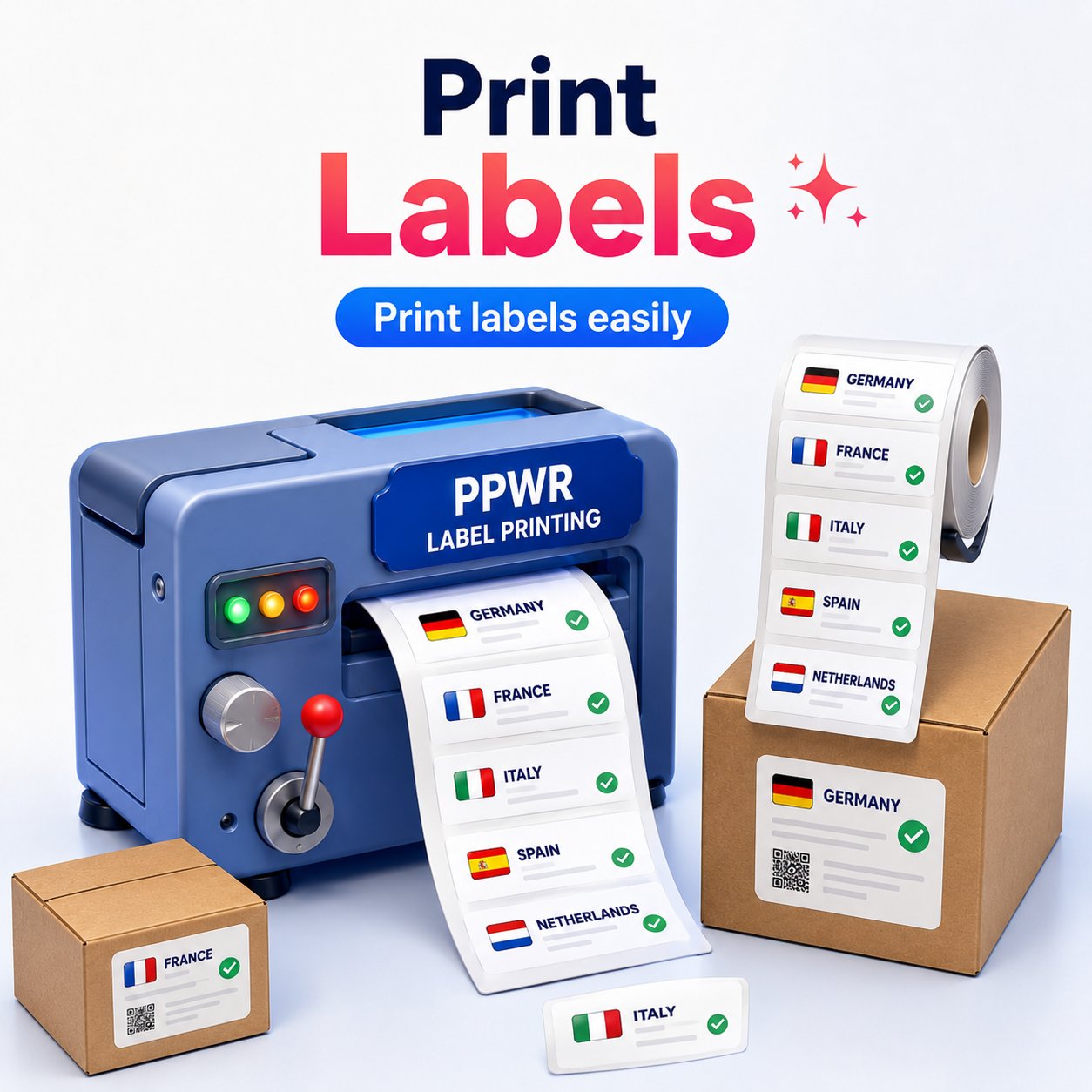 Print PPWR packaging labels
Create a print-ready label with PPWR-ID, name and address — matching the declaration you just downloaded. Free of charge, no extra payment needed.
Want to be sure your declaration is complete?
In an initial consultation (from €99) we go through your declaration point by point against Annex VIII and tell you which details or documents are still missing – in writing, in your language.
Request a consultation →💬 Something unclear, or a field not working?
Drop us a quick note — we usually reply within 24h.