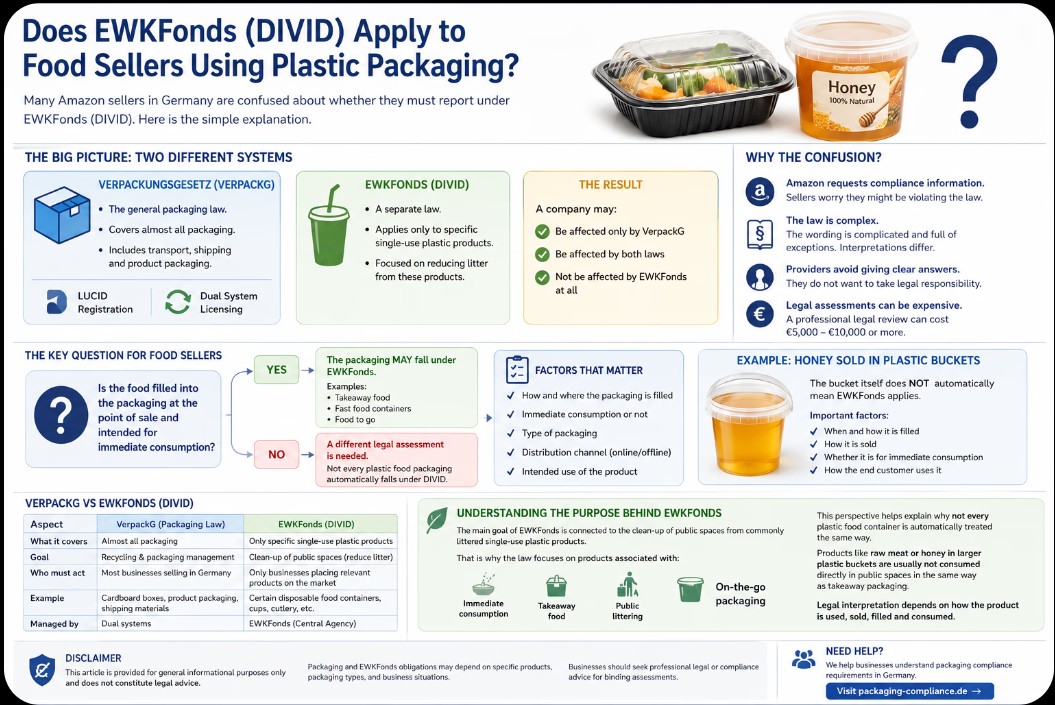
Many Amazon sellers in Germany are unsure whether they must report under the Single-Use Plastics Fund (EWKFonds / DIVID). The uncertainty is especially common among food sellers using plastic packaging.
One major reason: Amazon increasingly requests compliance information, so sellers worry about violations even where the law itself is genuinely difficult to interpret.
Status of this article: All details were verified in August 2026 against the EWKFondsG and the publications of the German Environment Agency. Since November 2025 there is a new rule that settles this exact question for many food sellers.
Why this is so confusing
The Single-Use Plastics Fund applies only to certain disposable plastic products. Many sellers, however, struggle to determine whether their packaging actually falls under the law.
It gets particularly complicated for honey sellers, food brands, importers and anyone using plastic buckets or containers.
The 500-gram threshold: the clearest answer since November 2025
This is the most important development, and many older articles do not yet reflect it. On 3 November 2025, the UBA introduced a quantity threshold by administrative provision.
Packets, wrappers and food containers whose intended food content exceeds 500 grams are no longer regarded as products for immediate consumption — and are therefore not subject to the levy.
What this means for honey: a honey bucket containing 1 kilogram or 2.5 kilograms is clearly above the threshold. Under current administrative practice it therefore falls outside the levy obligation. A 250-gram jar or a small portion pack would still need assessment.
The threshold applies equally to empty food containers such as take-away boxes or salad bowls. Where the later fill quantity is unknown, the typical fill weight of comparable containers is used.
Practical consequence: family and bulk packaging for baked goods, delicatessen products, meat and ready meals is now largely relieved. If you have already reported quantities above this threshold for earlier periods, review your declarations and have them corrected where necessary.
The distinction many sellers miss
Independently of the quantity threshold, one basic criterion applies: what matters is whether the packaging is intended for immediate consumption — food eaten directly without further preparation, typically on the go.
That is exactly where the confusion starts: many packaged foods sold online do not automatically fall into the same category as a takeaway box.
Example: honey in plastic buckets
At first glance a plastic honey bucket looks like single-use plastic packaging. The legal classification, however, depends on how and when the product is filled, whether it is intended for immediate consumption, and how it reaches the consumer.
Since November 2025 the case can usually be settled far more quickly: if the content exceeds 500 grams, the levy obligation for that packaging falls away. That resolves the industry's most common dispute for the large majority of honey buckets.
The logic behind the fund
What makes this much easier to grasp is the purpose of the fund. At its core it is a fund for cleaning public spaces — financing street bins, park cleaning and litter removal.
That is why the law focuses on products associated with immediate consumption, takeaway food, public littering and on-the-go packaging.
This perspective explains why not every plastic food container is treated the same way. Raw meat or honey in larger plastic buckets is normally consumed at home and disposed of via household collection — it does not end up as litter in a park. A takeaway coffee cup does.
Once you internalise that logic, you can assess most borderline cases yourself: is this product typically consumed on the go, with the packaging then discarded in a public space?
Which product types are covered at all
What counts is the exhaustive list in Annex 1 of the EWKFondsG. Only the product types named there trigger a payment obligation:
If your packaging type is not on that list, no levy obligation arises — regardless of how much plastic it contains.
The VerpackG and the fund are two separate systems
Many sellers confuse the Packaging Act with the Single-Use Plastics Fund. These are different systems with different rules — a company may have obligations under the VerpackG but not under the EWKFondsG.
This is one of the biggest misunderstandings among sellers new to Germany. Paying a dual system does not replace the EWKF levy — and vice versa.
Why sellers are afraid
Many Amazon sellers fear compliance violations, Amazon restrictions, legal risk and fines. Some businesses therefore consider expensive legal opinions simply to establish whether they are affected at all.
For smaller operations, paying substantial sums only to learn the law may not apply feels disproportionate. That is exactly why it is worth working through the two simple checks first: is my product type in Annex 1? And does the content exceed 500 grams?
Why nobody wants to give a clear answer
Another issue: many service providers avoid definitive statements. The law is complex and product-specific, and nobody wants to take on the liability.
Businesses are left uncertain whether they must register, whether they must report, or whether their packaging falls outside the scope. The 500-gram threshold has, however, substantially narrowed that grey zone for food packaging.
Careful analysis still matters
Determining packaging obligations in Germany still requires close attention to product type, packaging type, filling process, sales channel and legal definitions — especially for food.
But two questions already take you a long way: is my product type listed in Annex 1 at all? And does the intended content exceed 500 grams?
Final thoughts
Interpreting the Single-Use Plastics Fund is demanding for food sellers using plastic packaging. Many Amazon sellers assume all plastic food packaging automatically falls under the law — the reality is more nuanced.
Understanding the difference between packaging law and single-use plastics regulation is extremely important for businesses selling in Germany. Since November 2025, the 500-gram threshold finally gives many food sellers a clear reference point.
Note: This article is provided for general information and does not constitute legal advice. Packaging and EWKFonds obligations depend on specific products, packaging types and business situations. For binding assessments, businesses should seek professional advice.
Official sources
- PPWR — Regulation (EU) 2025/40 (EUR-Lex)
- Central Agency Packaging Register (ZSVR)
- LUCID — packaging register
- Packaging Act (VerpackG)
- VerpackG § 36 — penalty provisions
- Single-Use Plastics Fund — DIVID platform
- German Environment Agency: EWKF page
- Stiftung EAR — WEEE