The Packaging and Packaging Waste Regulation (EU) 2025/40 (PPWR) has applied since 12 August 2026. Many sellers are only now noticing that something is missing for their packaging: a declaration of conformity, data from the supplier or labelling. Sometimes it is more serious: a limit for harmful substances is exceeded.
This article covers who is affected, the kinds of non-compliance, what the regulation requires in each case and how to fix it in practice. Every statement links to the text of the regulation.
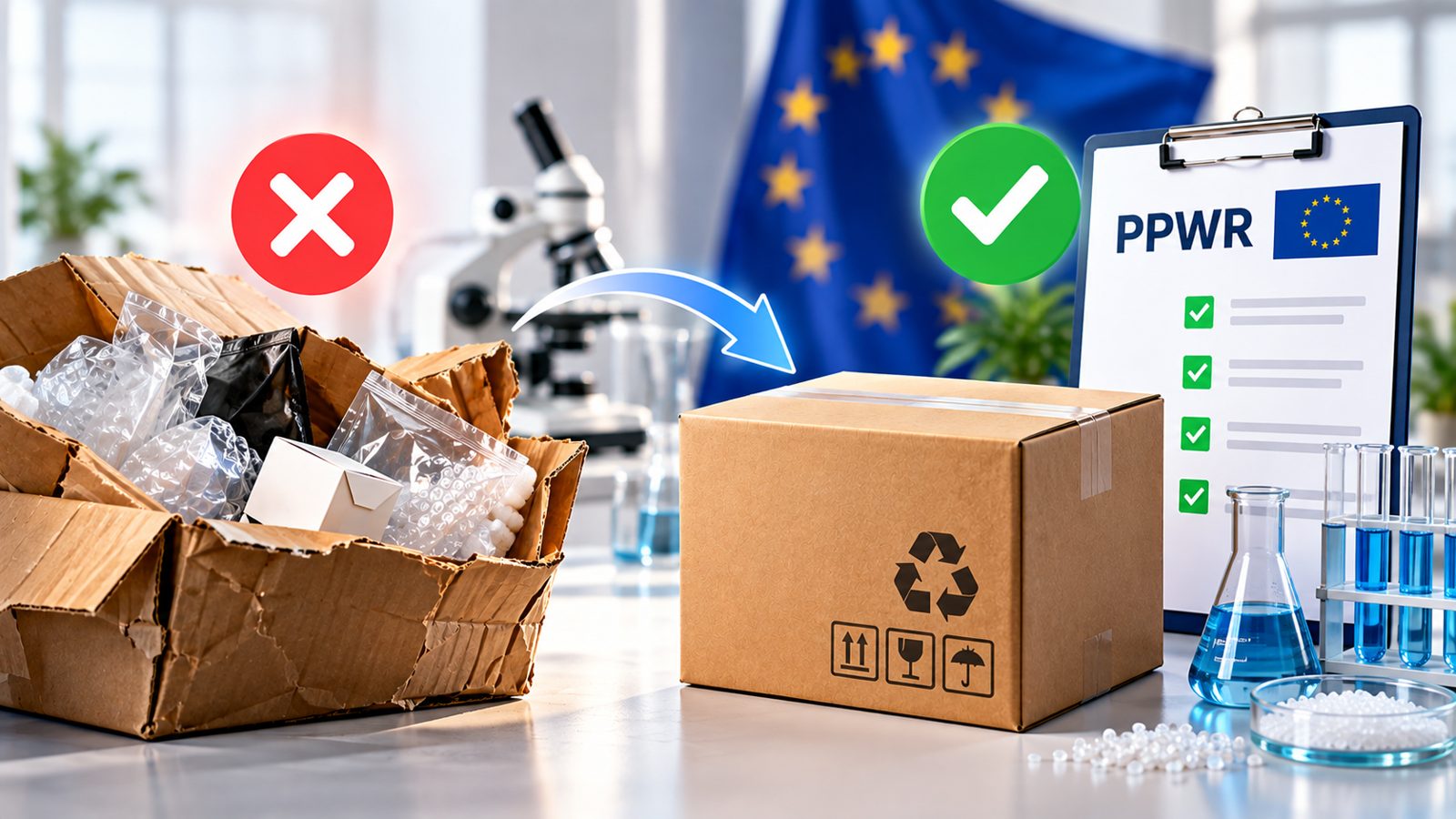
Does this concern you?
Yes, if you sell packaged goods in the EU – even if your supplier makes the packaging. The regulation assigns obligations by role, and every seller has at least one of these roles:
- Manufacturer – you sell goods under your own name or brand (even if a factory in China makes them for you) or you modify the packaging (Art. 21 PPWR). For most Amazon sellers, this is you.
- Importer – you bring goods into the EU yourself from a country outside it (Art. 18 PPWR). A seller is often both manufacturer (own brand) and importer (imports themselves).
- Distributor – you resell goods of another brand without changing the packaging (Art. 19 PPWR).
Two kinds of non-compliance – and why it matters
The regulation distinguishes two kinds of non-compliance. What you have to do depends on which one applies.
- A requirement for the packaging itself is not met (Art. 5–12 PPWR). In practice today this mainly means substances under Art. 5 PPWR: heavy metals (lead, cadmium, mercury, hexavalent chromium) above 100 mg/kg in total, or PFAS ("forever chemicals") above the limits in food-contact packaging. The other requirements of Articles 6–12 (recyclability, recycled content, material labelling) apply later.
- Formal non-compliance (Art. 62 PPWR). The packaging itself is fine, but the declaration of conformity is missing or incorrect; the technical documentation is missing or incomplete; or the packaging lacks the identification number or the manufacturer's name and address (Art. 15 PPWR, para. 5 and 6).
Problem – what to do – how long
| Problem | What to do | How long |
|---|---|---|
| No declaration of conformity | Draw up the declaration, e.g. with the PPWR declaration generator; request the supplier data in parallel | from 1 day |
| No technical documentation | Collect supplier answers, specifications, test results | a few days to a few weeks |
| No ID number or manufacturer contact on the packaging | Labels on remaining stock (e.g. from the PPWR label generator), print on the packaging for new batches | from 1 day |
| Supplier does not confirm heavy metals | Ask again point by point, lab test if in doubt | 1 to 4 weeks |
| PFAS above the limit in food packaging | Stop sales until fixed, change packaging or supplier | weeks, sometimes months |
Times are estimates and depend on the supplier and the lab.
Situation 1: the product is not on sale yet
If you know or suspect that the packaging does not meet the requirements, do not place it on the market until this is fixed. For importers this is stated explicitly in Art. 18 PPWR (para. 2), for distributors in Art. 19 PPWR (para. 3). For manufacturers it follows from the declaration, in which they confirm conformity under their sole responsibility.
Situation 2: already on sale, a packaging requirement is not met (Art. 5–12)
Art. 15 PPWR, para. 8 applies. You must:
- immediately take corrective measures – bring the packaging into conformity, withdraw it from the market or recall products already sold, as appropriate;
- immediately inform the market surveillance authority of every EU country where the packaging was made available about the suspected non-compliance and the measures taken.
Situation 3: already on sale, formal non-compliance
Fix it as soon as possible: draw up the declaration, compile the documentation, add the missing information. Art. 15 PPWR, para. 8 does not require you to report this to the authority yourself. But if the authority finds the non-compliance, it will require you to end it (Art. 62 PPWR). If it persists, the authority can prohibit sales or require withdrawal and recall. The European Commission confirms this order in its guidance: first a request to fix it, a ban only if the non-compliance is not remedied.
What corrective measures look like in practice
A corrective measure is not necessarily a recall. The regulation names three options, and the first is often enough:
- Bring the packaging into conformity. Put a label with the ID number and manufacturer contact on remaining stock, repack the goods, replace a problematic part (e.g. the lid), complete the documents.
- Withdraw the product from sale while the packaging is being fixed – e.g. deactivate the marketplace listing temporarily.
- Recall products already sold from customers. This is the last resort for serious cases, e.g. when a harmful-substance limit is exceeded in food packaging.
The measure depends on the non-compliance. If a label is missing, a recall from customers is usually disproportionate. If harmful substances exceed the limits, it may be necessary. The final assessment can be made by the market surveillance authority.
Examples (typical situations)
1. Honey in glass jars, new batch. A seller in Germany is preparing a new batch. The jar supplier has sent data on heavy metals, the lid supplier has not yet. The lid seal touches the honey, so PFAS data is needed for the lid as well. The seller fills in the declaration and sends the lid supplier a 4-point request. When the answer arrives, it goes into the technical documentation. If the answer reveals a problem, the seller acts as in situation 1 or 2.
2. Household goods in an Amazon FBA warehouse. The seller imports the goods from China themselves, so they are the importer. After 12 August they notice that the boxes lack the identification number and the manufacturer's address, and their own address as importer is missing too (Art. 18 PPWR, para. 3). Part of the stock is already sold. This is formal non-compliance. The boxes in the warehouse were produced before 12 August 2026: according to the European Commission's guidance, this information can be provided for such stock in an accompanying document instead of relabelling. The seller still labels the remaining stock because it is easier to check, and the supplier prints the data on new batches. Recalling boxes already sold is usually disproportionate in such a case. The seller records every step in the technical documentation.
3. Food packaging suspected of PFAS. A seller sells baked goods in paper bags with a grease-resistant coating. The supplier cannot confirm that the bags are PFAS-free, and a lab test shows the limit is exceeded. This breaches Art. 5 PPWR. The seller immediately stops sales, switches to a different bag and informs the market surveillance authority about the non-compliance and the measures taken.
4. Distributor. A seller buys finished goods from a wholesaler in Germany and resells them under the manufacturer's brand without changing the packaging. They are not the manufacturer but a distributor (Art. 19 PPWR). Before selling, they check that the packaging carries the identification number and the manufacturer's contact details. If this information is missing, they do not list the product until it is added.
How to document the fix
Everything you did must be visible in the technical documentation – authorities can request it (Art. 15 PPWR, para. 10). Record:
- what was found and when;
- which products and batches are affected;
- which measures were taken and when (label, repacking, new supplier, stop of sales);
- new documents: supplier answer, test results, updated declaration;
- if you notified the authority – a copy of the notification and the date.
What to include in the notification to the authority
The regulation requires you to report the suspected non-compliance and the measures taken (Art. 15 PPWR, para. 8). In practice the notification includes:
- who you are: manufacturer or importer;
- which packaging and products, batch numbers;
- in which countries it was sold;
- what the non-compliance is;
- which measures were taken.
For a specific letter to the authority, it is best to consult a consultant or a lawyer.
Remaining stock: can old packaging still be used?
According to the European Commission's guidance (PPWR FAQ, 2nd edition, August 2026), packaging produced before 12 August 2026 and not yet placed on the market does not have to be destroyed, remanufactured or relabelled. The identification number and the manufacturer's name and address can be given for it in an accompanying document.
However, the declaration of conformity, the technical documentation and the substance limits (heavy metals, PFAS) also apply to this stock. There is no relief here.
A separate period exists for the future material labelling under Art. 12 PPWR: packaging manufactured or imported before the relevant date may be made available for up to 3 more years (Art. 12 PPWR, para. 12).
The Commission's guidance is not legally binding. The final interpretation lies with the authorities and courts.
If the authority requests documents
- You must provide the documents within 10 days of receiving the request (Art. 15 PPWR, para. 10) – electronically, and on paper if requested.
- They must be in a language the authority can easily understand.
- You must cooperate with the authority on measures to eliminate the non-compliance.
Checklist: check your packaging before selling
- Is there a declaration of conformity in the language of each country of sale?
- Have you asked your supplier for data on the 4 points: material, heavy metals, PFAS and Regulation 1935/2004 (the last two only for food packaging)? We recommend this request. The answer is kept in the technical documentation.
- Is the technical documentation complete?
- Does the packaging carry an identification number?
- Does the packaging show the manufacturer's name and address – and, if you import yourself, yours as importer?
- If you changed anything about the packaging, have you become its manufacturer?
How we help – and when you need a lawyer
In an initial consultation (from €99) we work out which requirement is affected, which documents are missing and in which order to act. If a fine is threatened or proceedings are already under way, you need a lawyer – we do not provide legal advice.
FAQ
Do I have to notify the market surveillance authority myself?
If a packaging requirement under Art. 5–12 PPWR is not met (e.g. a harmful-substance limit is exceeded), yes, immediately (Art. 15 para. 8). For formal non-compliance (no declaration, no ID number or manufacturer contact) Art. 15 para. 8 does not require a notification, but you must fix it quickly.
Can I keep selling while the problem is being fixed?
If requirements of Art. 5–12 are not met, no: the product must be withdrawn or brought into conformity. Formal non-compliance must be fixed as soon as possible. If the authority finds it and it persists, it can prohibit sales (Art. 62 PPWR).
What fines apply?
Each EU country sets its own penalties. Countries must adopt their penalty rules by 12 February 2027 (Art. 68 PPWR). Amounts will differ between countries.
Can I sell remaining stock in old packaging?
According to the European Commission's guidance, packaging produced before 12.08.2026 does not have to be relabelled: the ID number and manufacturer data can be given in an accompanying document. The declaration, documentation and substance limits also apply to remaining stock.
What if my supplier does not answer?
You do not have to wait for the answer to fill in the declaration. Ask again point by point and request any existing documents. If you have specific doubts, e.g. about PFAS in food packaging, have a lab test only what is missing.
General information, not legal advice. As of 30.09.2026.
Sources
- Regulation (EU) 2025/40 (PPWR) — Art. 5, 12, 15, 18, 19, 21, 62, 68
- European Commission: Frequently asked questions on Regulation (EU) 2025/40, 2nd edition, August 2026